Here is a side-by-side look at the main features of brass vs bronze for CNC machining:
You can see that brass vs bronze is not just about price. Brass gives you speed and easy machining. Bronze gives you more strength and better performance in tough jobs. When you choose between them, think about what matters most for your project.
Cutting Speed & Tool Wear
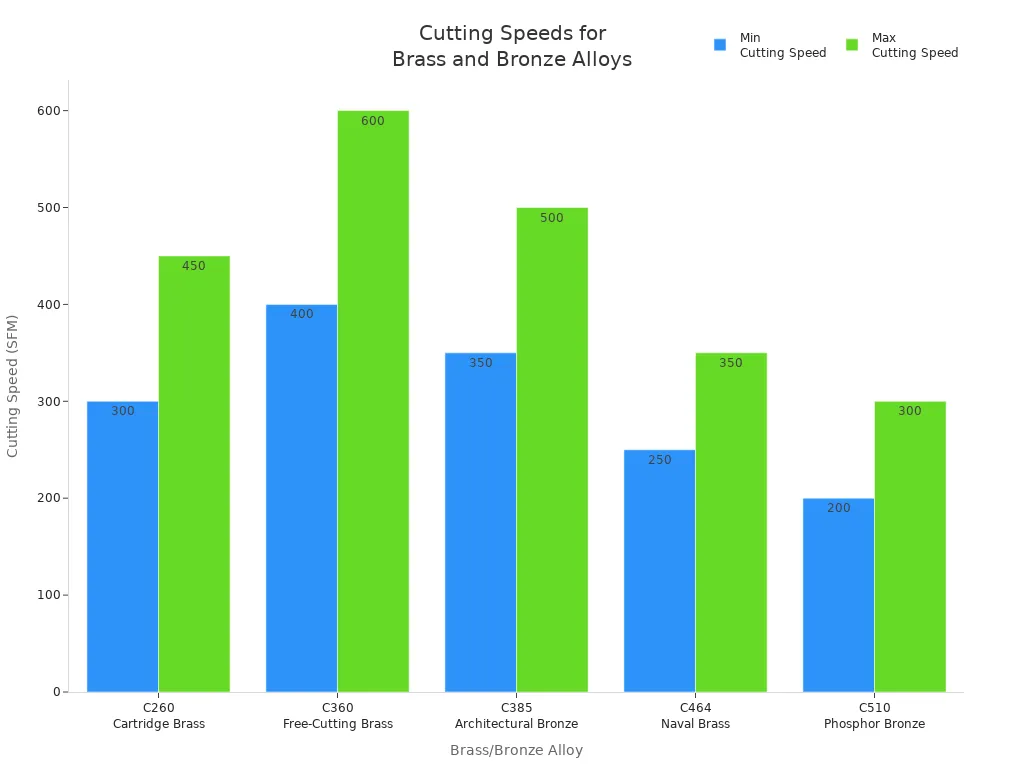
When you compare brass and bronze, you will see big differences in how they affect your tools and machine settings. Brass lets you use higher cutting speeds. For example, C360 brass can run at 400 to 600 surface feet per minute (SFM). Bronze needs slower speeds, usually around 200 to 300 SFM for phosphor bronze. You should use carbide end mills with TiN coatings for bronze. This helps your tools last longer. Brass causes less tool wear because zinc acts like a lubricant. Bronze is harder and more abrasive. This means your tools will wear out faster when you cut bronze.
Material | Recommended Cutting Speed (SFM) | Tool Wear Rate |
Brass | 300-600 | Low |
Bronze | 200-350 | Higher |
Tip: Always use a water-based coolant when machining bronze. This helps control heat and manage the tough chips.
Chip Formation
Brass vs Bronze also shows clear differences in chip formation. Brass makes short, brittle chips that break away easily. This keeps your workspace clean and reduces the risk of machine jams. Bronze forms tougher, longer chips. These can wrap around your tool or workpiece if you do not use the right feed rates and coolant. Both metals can make discontinuous chips, but bronze chips are harder to manage.
Factor | Brass | Bronze |
Chip formation | Short, easy to clear | Tougher, longer chips |
Cutting forces | Low | Medium to high |
Risk of jams | Low | Higher |
Surface Finish
You will get a smoother surface finish with brass. Brass machines easily and gives you a shiny, almost mirror-like look. You often do not need extra polishing. Bronze is harder and can work harden during machining. This makes it more difficult to get a perfect finish. You may see rougher surfaces unless you use special cutting tools and strategies. The CNC Machine for Steel Tower from SHANDONG FIN CNC MACHINE CO., LTD. can help you achieve high-precision finishes, especially when you choose the right material and settings.
Note: If you want the best surface quality with less effort, brass is the better choice. For bronze, plan for extra steps to reach the same level of smoothness.
Cost & Availability
Price Comparison
You need to know how much brass and bronze cost before you start your CNC machining project. Brass usually costs less than bronze. Right now, you can buy brass for about $3.75 per pound if you order a large amount, like 2500 pounds. Bronze costs more because it contains more copper and sometimes other special metals. These extra metals make bronze stronger, but they also raise the price. You will find that brass is not only cheaper to buy, but also easier to machine. This means you spend less money on tools and production. Bronze, on the other hand, increases your machining costs. You pay more for the raw material and for the extra time and tool wear during machining.
Note: If you want to keep your project budget low, brass is the better choice. Bronze works best when you need extra strength and durability, even if it costs more.
Sourcing Considerations
You must think about how easy it is to get brass and bronze for your CNC machining job. Brass is easy to find in grades that work well for machining. Bronze is harder to source because it uses more copper and special alloying elements. These factors can make bronze less available and more expensive.
Brass is easier to machine. You can use faster speeds and get smoother results.
Bronze needs slower machining. You must use careful settings to avoid tool damage.
Bronze causes more tool wear. You will replace your cutting tools more often.
Machining bronze takes longer. You spend more time on each part because bronze needs higher cutting forces.
Brass helps you manage costs. You save money on material and machining.
Bronze increases your costs. You pay more for the material and for the extra machining steps.
You should check your supplier’s inventory before you start. Make sure you can get the material you need in the right grade and size. If you want to save time and money, brass is usually easier to source and machine. Bronze is best for projects where strength and wear resistance matter most.
Strength & Durability
Mechanical Properties
You need to know how strong and tough your material is before you start CNC machining. Brass and bronze both have good strength, but they are not the same. Brass gives you medium strength and is easy to bend. Bronze is tougher and can handle more stress. This makes bronze a better choice for parts that need to last a long time or carry heavy loads.
Here is a table that shows the main mechanical properties:
Alloy Type | Tensile Strength (MPa) | Hardness (HB) |
Bronze | 350 - 635 | 40 - 420 |
Brass | 338 - 469 | 55 - 73 |
Copper | 210 | 35 |
Bronze alloys can be much harder than brass. Some bronze alloys, like C954 and C63000, have very high hardness and strength. These alloys work well in tough jobs.
Bronze Alloy | Rockwell B (HRB) | Key Characteristics |
C932 | 55-65 | Good anti-frictional properties |
C954 | 85-100 | High strength, excellent wear resistance |
C863 | 80-95 | Very high strength, good for heavy loads |
C510 | 70-85 | Good spring qualities |
C63000 | 90-100 | Very high strength, excellent corrosion resistance |

You can see that bronze can reach higher hardness levels than brass. This means bronze parts can handle more force and last longer in tough conditions.
Wear Resistance
Wear resistance tells you how well a material stands up to rubbing, friction, and repeated use. Bronze usually outperforms brass in this area. You should pick bronze if your part will face a lot of movement or sliding.
Bronze is the best choice for parts that deal with friction, like bearings and gears.
Bronze keeps its shape and strength even after many cycles of use.
In jobs where surfaces slide against each other, bronze resists damage better than brass.
Bronze’s toughness means your parts will last longer, especially in machines that run all day.
Brass works well for parts that do not face much friction. If you need something for high-wear or high-stress jobs, bronze is the smarter pick. You get better performance and a longer lifespan for your CNC machined parts.
Corrosion Resistance & Applications
Environmental Performance
You should think about how your material will do in different places. Both brass and bronze can resist corrosion, but they are not the same. Bronze is better if your part will be in harsh or dangerous conditions. Tin bronze and aluminum bronze can handle saltwater and many chemicals. This makes bronze a great pick for boats and factories. Brass can lose zinc when it is in tough places. This is called dezincification, and it makes brass weaker over time. Some brass with manganese does better, but most brass is not as good as bronze for corrosion resistance.
Tip: Pick bronze for CNC machined parts that will touch water, chemicals, or be outside. Bronze gives you better protection and helps your parts last longer.
Brass can corrode more in rough places.
Bronze stays strong and keeps its shape even in salty or chemical-filled spots.
Bronze is best for jobs with heavy loads or lots of wear where corrosion could happen.
Typical Uses
Brass and bronze are used in many jobs because each one has special strengths. Brass is liked because it is easy to machine and looks nice. You see brass in plumbing, electronics, and car parts. Bronze is used for tough jobs and in places with water.
Industry/Application Area | Common Brass Components | Common Bronze Components | Why Use This Material? |
Electronics | Connectors, Terminals, Pins | Electric Parts, Connectors | Brass: Conductivity; Bronze: Oxidation Resistance |
Automotive | Sensor Housings, Hose Fittings | Bushings, Bearings | Brass: Durability; Bronze: Wear Resistance |
Plumbing | Valves, Faucets, Pipe Fittings | Valve Components | Brass: Corrosion Resistance; Bronze: Marine Use |
Industrial Machinery | Gears, Bearings, Bushings | Gears, Worm Drives, Pump Parts | Brass: Low Friction; Bronze: Strength, Quiet Operation |
Use brass for screws, valves, and fittings when you want easy machining and a smooth finish.
Choose bronze for bearings, gears, and pump parts that need to last in wet, tough, or high-friction places.
Remember: You should always pick the material that fits your job. This helps you get the best results.
Choosing Brass or Bronze
When to Use Brass
Pick brass if you want easy machining and a smooth finish. Brass is good for making lots of parts fast. You can cut it quickly and get exact sizes. If your part needs small details or threads inside, brass alloys like C360 help a lot. Brass is also great when you need your project done fast. It saves time and money because it cuts faster and does not wear out tools as much.
Brass works best in these cases:
Use it for shiny trim and hardware.
It is good for door handles and window frames that need to look nice and be strong.
Brass is used in car parts like valves and fittings that must last and not rust.
It is used in airplane parts where you need things to be exact and work well.
Brass is picked for electrical connectors and switches because it carries electricity and is easy to machine.
It is used in plumbing because it does not leak or get water damage easily.
Brass is good for marine pumps and valves since it fights off rust from water.
If you want a material that is easy to find and does not cost too much, brass is a smart choice. You get good results and a smooth finish without right much work.
When to Use Bronze
Choose bronze if your parts need to be extra strong and last a long time. Bronze can handle heavy loads and lots of rubbing. This makes it perfect for ride jobs. If your project will be in a tough place, bronze protects better from rust than brass. Bronze alloys are great for boats and factories where saltwater or chemicals can hurt other metals.
Bronze is best for these uses:
Use it for bearings, bushings, and gears that move a lot and rub together.
It is good for pump parts and valve pieces in boats or chemical plants.
Bronze is used in machines that run all day and need parts to last.
It works for outdoor gear that faces rain, water, or chemicals.
Pick bronze when you need parts to be very hard and strong for safety.
Bronze helps your parts last longer in hard places. You get parts that do not rust or wear out fast.
Tip: If you are not sure which to pick, SHANDONG FIN CNC MACHINE CO., LTD. can help. Their CNC machines, like the CNC Machine for Steel Tower, give you high accuracy and good results for any job.
Project Checklist
Check this list before you own pick brass or bronze for CNC machining. This helps you choose the right material for your project.
Checklist Item | Considerations |
Strength and fatigue | See if the alloy is strong enough and can handle stress. |
Stress-corrosion cracking (SCC) risk | Pick alloys that resist cracking if your part will be in salty places. |
Manufacturing process and yield | Choose alloys that work well with your way of making parts, like CNC machining or cold heading. |
Budget and lead time | Use common brasses to save money and time. Pick special alloys if you need more strength. |
Regulations and sustainability | Do not use leaded brasses if you need safe or green materials. Think about the environment too. |
Ask yourself these questions:
Does your part need to be very strong or hold heavy things?
Will your part touch water, chemicals, or be outside?
Do you need a smooth look or exact sizes?
Is your project due soon or do you need it fast?
Are there rules about the material being safe or good for the earth?
You can make the best choice by matching your answers to the checklist. SHANDONG FIN CNC MACHINE CO., LTD. can help you pick the right material and give you expert CNC machining for your project.
You should pick brass if you want easy machining and a smooth finish. Brass also costs less than bronze. Bronze is better for jobs where parts rub together a lot or need to be very strong. It works well in tough places. Look at the table below for a quick guide:
Material | Machinability | Cost | Application |
Brass | Easier to machine | Less expensive | Mass-produced parts, fittings, plumbing |
Bronze | More difficult to machine | More expensive | High-wear applications like bearings and bushings |
Experts say brass helps your tools last longer and gives a nicer finish.
Always think about how strong, tough, and rust-proof you need your part to be.
For the best advice, talk to CNC experts at SHANDONG FIN CNC MACHINE CO., LTD.
FAQ
What makes brass easier to machine than bronze?
Brass has a softer structure and forms short chips. You can cut it faster and get a smooth finish. Bronze is harder and creates tougher chips, which makes machining slower.
Can you use brass or bronze for outdoor parts?
You can use both metals outside. Bronze resists corrosion better, especially in salty or wet places. Brass works well for decorative parts but may weaken in harsh environments.
Which material costs less for CNC machining?
Brass usually costs less. You spend less on raw material and tool wear. Bronze is stronger but costs more because it contains more copper and special alloys.
Do brass and bronze need special tools for CNC machining?
You can use standard carbide tools for brass. Bronze needs tougher tools, like carbide with coatings. This helps your tools last longer and keeps your parts accurate.
How do you choose between brass and bronze for your project?
You should check your project needs. Pick brass for easy machining and smooth finishes. Choose bronze for strength, wear resistance, and harsh environments. Ask experts at SHANDONG FIN CNC MACHINE CO., LTD. for advice.