In modern manufacturing, precision isn't just a goal; it's the baseline. The term CNC, which stands for Computer Numerical Control, represents the technology that makes this precision possible on a massive scale. It's the digital brain that commands a machine's every move. This technology evolved from early Numerical Control (NC) systems, which used punched tape, into the sophisticated, software-driven processes we see today. Understanding the CNC meaning is crucial because it is the standard for achieving unparalleled accuracy, repeatability, and scalability in industrial production. From crafting a single, complex aerospace component to producing thousands of identical parts, CNC is the engine driving efficiency. This guide will demystify the entire CNC ecosystem, from its core logic to its real-world applications and business implications.
Key Takeaways
Core Logic: CNC translates digital designs into physical parts via G-code and M-code.
Precision Advantage: Capability to achieve tolerances as tight as ±0.05 mm, far exceeding manual capabilities.
Industrial Efficiency: Specialized lines (like Angle Punching or Plate Drilling) automate multi-step processes into a single workflow.
Decision Factor: Transitioning to CNC requires balancing higher upfront TCO (Total Cost of Ownership) against long-term ROI through reduced labor and scrap.
Understanding the CNC Ecosystem: From Logic to Hardware
At its heart, CNC technology is a system that converts a digital file into a series of commands that a machine tool can follow. This ecosystem combines sophisticated software, precise hardware, and a specific programming language to transform raw material into a finished product with minimal human intervention during the cutting process.
The Subtractive Manufacturing Concept
CNC machining is a prime example of subtractive manufacturing. The process starts with a solid block of material (a blank) and methodically removes, or subtracts, material to reveal the final shape. This is the direct opposite of additive manufacturing, commonly known as 3D printing, where a part is built layer by layer from nothing. While 3D printing is excellent for rapid prototyping and complex internal geometries, subtractive CNC methods are superior for projects requiring high strength, tight tolerances, and excellent surface finishes from materials like steel, aluminum, or titanium.
The "Brain" (MCU)
The Machine Control Unit (MCU) is the central nervous system of any CNC machine. This specialized computer reads the instructional code from a digital file and translates it into electrical signals. These signals control the motors, spindles, pumps, and other components of the machine. The MCU precisely dictates the tool's path, speed, and feed rate, ensuring that every movement aligns perfectly with the digital blueprint.
Positioning Systems
A machine's ability to produce accurate parts depends entirely on its positioning system. It needs to know exactly where the tool is at all times. This is managed through two primary system types.
Open-Loop vs. Closed-Loop
An open-loop system sends instructions to the motors but has no way to verify if the movement was executed correctly. It assumes the tool went to the commanded position. These are simpler and less expensive but are susceptible to errors from motor stalls or mechanical slip. A closed-loop system, on the other hand, incorporates feedback devices like encoders or resolvers. These devices constantly report the tool's actual position back to the MCU. The controller can then compare the actual position to the commanded position and make real-time corrections. For high-stakes industrial accuracy, closed-loop systems are non-negotiable.
Cartesian Coordinates
CNC machines navigate using the Cartesian coordinate system. The most basic machines operate on three axes:
X-axis: Left-to-right movement.
Y-axis: Front-to-back movement.
Z-axis: Up-and-down movement.
More advanced machines can include rotational axes (A, B, C), allowing for 5-axis machining. This enables the cutting tool to approach the workpiece from virtually any angle, making it possible to create highly complex geometries in a single setup.
The Language of CNC
The MCU understands a specific programming language, primarily composed of G-code and M-code. These codes are the fundamental instructions that tell the machine what to do.
G-Code
G-code, or geometric code, controls the machine's motion. It tells the tool where to go, how fast to move, and what path to follow. For example, `G00` commands a rapid move to a specific coordinate, while `G01` commands a linear feed move (a controlled cut). Each line of G-code provides a precise instruction for the machine's geometry and movement.
M-Code
M-code, or miscellaneous code, manages the machine's auxiliary functions. These are the non-cutting actions. For instance, `M03` starts the spindle rotating clockwise, `M08` turns on the coolant, and `M05` stops the spindle. G-code and M-code work together to create a complete program that orchestrates the entire machining process.
Specialized CNC Applications in Heavy Industry
While general-purpose CNC mills and lathes are common, heavy industry often relies on specialized, high-output machines designed for specific tasks. These machines integrate multiple processes into a single, automated workflow, dramatically increasing throughput and consistency for structural steel fabrication, tower construction, and similar large-scale projects.
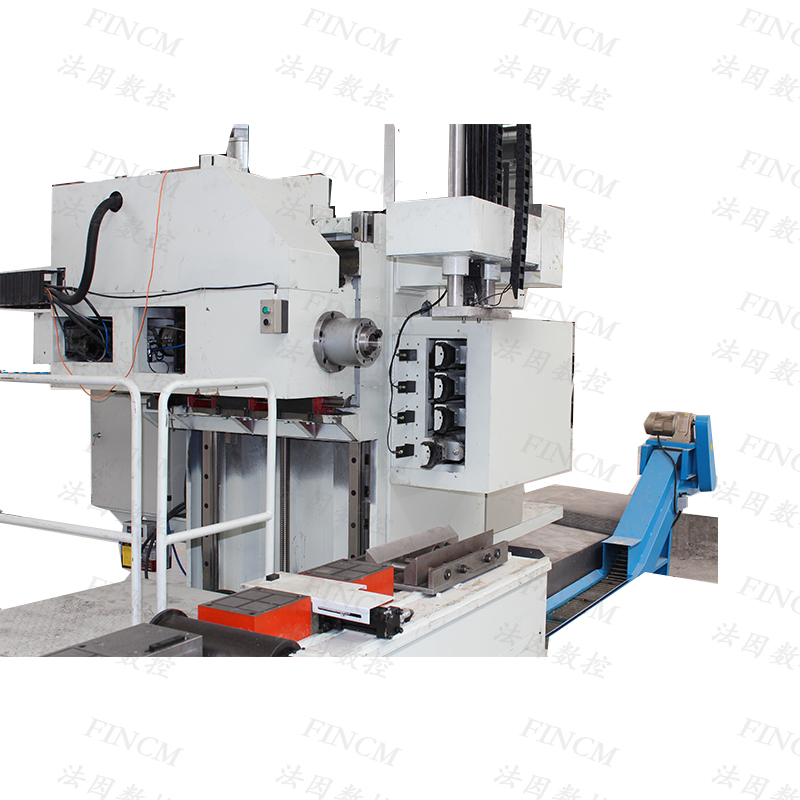
CNC Angle Punching Shearing Marking Line
In structural steel processing, angle iron is a fundamental component. A CNC Angle Punching Shearing Marking Line is an integrated system designed to handle this material with extreme efficiency. Instead of moving a long piece of angle iron between three separate manual stations, this single machine automates the entire sequence.
Punching: The line uses hydraulic or mechanical presses to punch holes or slots at precise locations.
Shearing: A powerful shear cuts the angle iron to the exact required length.
Marking: It stamps or scribes part numbers, layout marks, or other identifiers onto the material.
This combination of operations within one CNC-controlled workflow eliminates material handling time, reduces the chance of human error, and ensures every finished piece is identical.
CNC Angle Drilling Marking Line
For applications where drilled holes are specified over punched holes, such as in high-tensile steel or certain engineering standards for power towers and telecommunications structures, the CNC Angle Drilling Marking Line is essential. In these structures, the accuracy of hole positioning is critical for structural integrity; a slight misalignment can compromise the entire assembly. This machine uses high-speed drilling spindles to create clean, precise holes, followed by automated marking. The CNC control guarantees that hole patterns are repeated perfectly across hundreds of components.
CNC Plate Punching Drilling Machine
Steel structures rely on connection plates, gusset plates, and base plates to join beams and columns. A CNC Plate Punching Drilling Machine is purpose-built to process these flat plates at high speed. These machines can handle large plates, automatically positioning them under the tooling head to punch or drill hole patterns derived directly from CAD files. When comparing technologies, hydraulic punching offers immense force for thick plates, while mechanical punching can provide higher cycle speeds for thinner materials. Many modern machines offer both drilling and punching capabilities for maximum flexibility.
The 4-Stage CNC Workflow: Design to Finished Part
Bringing a part from a concept to a physical object using CNC machining follows a standardized, four-phase workflow. Each stage builds upon the last, ensuring a seamless translation from digital design to physical reality.
Phase 1: Digital Design (CAD)
Everything starts with a digital blueprint. Using Computer-Aided Design (CAD) software like AutoCAD, SolidWorks, or Fusion 360, an engineer or designer creates a 2D or 3D model of the final part. This digital model contains all the necessary geometric information, including dimensions, tolerances, and surface finishes. A well-constructed CAD model is the foundation for the entire process.
Phase 2: Programming (CAM)
The CAD model is then imported into Computer-Aided Manufacturing (CAM) software. The CAM software's job is to convert the design into machine-readable G-code and M-code. The programmer selects the tools, defines the toolpaths, and sets cutting parameters like speed and feed rate. A critical component of this phase is the "Post-Processor," a piece of software that translates the generic CAM output into the specific dialect of code that the target CNC machine's controller understands.
Phase 3: Machine Setup
Before running the program, a skilled machinist must set up the machine. This involves several critical steps:
Workholding: Securely clamping the raw material (workpiece) onto the machine bed using vises, chucks, or custom fixtures. The workpiece must not move during the intense forces of machining.
Tool Installation: Loading the correct cutting tools into the machine's tool changer or spindle.
Setting Offsets: Measuring the exact length and diameter of each tool and inputting these values into the controller. This tells the machine the precise location of the tool tip.
"Zeroing" the Machine: Establishing the program's zero point (or datum) on the workpiece. This reference point ensures the machine knows where to start cutting in relation to the material. An incorrect setup can lead to a tool crash, damaging the machine, tool, and workpiece.
Phase 4: Execution & Monitoring
With the setup complete, the machinist runs the program. The machine executes the code line by line, moving the tool to cut the material. While the process is automated, the CNC machinist's role is not passive. They must monitor the operation, listen for unusual sounds (like tool chatter), check for chip buildup, and make real-time adjustments to feeds and speeds if necessary to optimize performance and ensure quality.
Evaluating the Business Case: Manual vs. CNC
Deciding whether to use manual machining or invest in CNC technology is a strategic choice based on production volume, part complexity, and long-term business goals. Each approach has its place, and understanding the trade-offs is key.
When to Stay Manual
Manual machining, where a skilled operator controls the machine's movements using handwheels and levers, remains viable in specific scenarios:
Low-Volume Prototyping: For one-off parts or simple prototypes, the time spent programming a CNC machine can exceed the time it takes to make the part manually.
Simple Geometries: Basic tasks like facing a block, drilling a few holes, or cutting a keyway can often be done faster on a manual mill or lathe.
Low-Capital Environments: Small job shops, repair facilities, or startups may not have the capital for a CNC machine, making manual equipment the only practical option.
When to Transition to CNC
The case for transitioning to CNC becomes overwhelming when certain production demands are met. The higher upfront cost is justified by significant gains in other areas.
| Factor | Manual Machining | CNC Machining |
| Complexity | Limited to what an operator can physically create. Complex curves and angles are difficult. | Can produce highly complex geometries, including 3D contours and intricate patterns, with ease. |
| Repeatability | Varies with operator skill and fatigue. Each part will have slight variations. | Virtually perfect. Can produce thousands of identical parts with zero variance, often to tolerances of ±0.05 mm or better. |
| Labor Efficiency | Requires constant, skilled operator attention. One operator per machine. | Reduces direct labor. One skilled operator can often oversee multiple machines running automated cycles. |
TCO & ROI Drivers
Evaluating the financial impact involves looking beyond the initial purchase price. The Total Cost of Ownership (TCO) and Return on Investment (ROI) are driven by several factors:
Capital Expenditure vs. Cost-Per-Part: CNC machines have a high initial cost, but their speed and automation lead to a much lower cost-per-part in medium to high-volume production.
Tooling & Software: Costs for specialized cutting tools, tool holders, and ongoing CAM software licenses must be factored into the TCO.
Maintenance: High-precision components like ball screws, linear guides, and spindles require regular, skilled maintenance to maintain accuracy, which is a recurring operational cost.
Implementation Realities: Risks and Success Criteria
Successfully implementing CNC technology involves more than just buying a machine. It requires a strategic approach to training, safety, materials, and quality control. Overlooking these realities can lead to costly mistakes and underutilized assets.
The Skills Gap
A significant challenge is the evolution of skills required. A manual machinist's expertise is in their hands-on feel for the machine. A CNC machinist's expertise lies in programming, setup, and process management. The transition requires a shift in mindset from "cranking handles" to "managing code." Companies must invest in specialized training for their workforce to bridge this skills gap and fully leverage the technology's capabilities.
Safety & Risk Mitigation
CNC machines are powerful and potentially dangerous. A simple programming error, such as a misplaced decimal point or incorrect tool offset, can lead to a "tool crash." This is a violent collision between the tool, the workpiece, or the machine itself, which can cause thousands of dollars in damage. Modern mitigation strategies are crucial:
Simulation Software: Before running a program on the real machine, it can be simulated in a virtual environment. This "Digital Twin" of the machine verifies the toolpaths and flags potential collisions.
On-Machine Probing: Using probes to automatically verify part location and tool dimensions can catch setup errors before a cycle begins.
Material Considerations
A CNC program is not one-size-fits-all. The optimal cutting parameters—spindle speed, feed rate, and depth of cut—change drastically depending on the material. Machining soft aluminum requires high speeds and aggressive feed rates to prevent material from gumming up the tool. In contrast, machining hardened steel or titanium requires much slower speeds, lower feed rates, and robust tooling to manage heat and cutting forces. The wrong parameters can lead to broken tools, poor surface finish, or a scrapped part.
Quality Management (QMS)
In regulated industries like aerospace, medical, and energy, just making a part to specification isn't enough; you must be able to prove it. Integrating CNC output with a robust Quality Management System (QMS) is essential. This often involves using a Coordinate Measuring Machine (CMM) to inspect critical dimensions of the finished parts. The inspection data is then documented to create a record of compliance, ensuring that every part meets the stringent industry standards for safety and reliability.
Conclusion
Ultimately, the core CNC meaning transcends simple automation. It represents a paradigm of controlled, scalable precision that has become the backbone of modern industry. CNC technology transforms digital intent into physical reality with a level of accuracy and consistency that is simply unattainable by manual means. The journey from a basic concept to a finished component is a systematic process built on the synergy of design, programming, and skilled execution.
The critical decision for any business is not whether to adopt CNC, but how. The choice of machine, from a general-purpose mill to a highly specialized, integrated solution like a CNC Angle Punching Shearing Marking Line, must be driven by specific throughput requirements and material complexity. As a next step, evaluate your current production bottlenecks and quality control challenges. This analysis will reveal the right level of CNC integration to unlock new levels of efficiency and capability for your operations.
FAQ
Q: What is the difference between CNC and NC?
A: The main difference is the "C" for computer. Older Numerical Control (NC) machines used punched paper tape with a fixed program. They had no memory or ability to edit the program on the machine. Modern Computer Numerical Control (CNC) machines use a computer with software to store, read, and edit programs, offering far greater flexibility, processing power, and user-friendliness.
Q: Is CNC machining expensive?
A: CNC machining has a high upfront cost for the machine, software, and training. However, for medium to high-volume production, it becomes highly cost-effective. The automation reduces labor costs, minimizes material waste from errors, and operates at speeds far exceeding manual methods. This leads to a significantly lower cost per unit in the long run.
Q: What materials can a CNC machine work with?
A: CNC machines are incredibly versatile and can work with a vast range of materials. This includes various metals (aluminum, steel, brass, titanium, copper), plastics (ABS, polycarbonate, nylon, PEEK), wood, foams, and composites like carbon fiber and fiberglass. The key is to use the correct cutting tools, speeds, and feed rates for each specific material.
Q: What is G-code?
A: G-code is the primary programming language that tells a CNC machine how to move. It's a series of commands that control the geometry of the toolpath. For example, specific G-codes instruct the machine to move in a straight line, cut an arc, drill a hole, or change coordinate systems. It is the fundamental instruction set for creating the shape of a part.
Q: Can CNC machines run 24/7?
A: Yes, many CNC machines are designed for "lights-out" manufacturing, meaning they can run unattended overnight or over weekends. This requires features like automatic tool changers, pallet systems to load new workpieces, and advanced monitoring systems that can detect tool wear or breakage and safely shut down the machine if an error occurs.


