In modern manufacturing, Computer Numerical Control (CNC) represents the bridge between digital design and physical reality. It is the automated control of machining tools and 3D printers by a computer, a technology that has propelled industries from manual, hands-on processes to the era of "lights-out" manufacturing, where facilities can run with minimal human intervention. This shift is especially critical in high-stakes sectors like aerospace, automotive, and structural steel fabrication, where precision is not just a goal but a strict requirement. Understanding the CNC meaning goes beyond a simple definition. This article will move past the basics to explore how CNC technology works, its specialized applications, and how to evaluate it as a strategic business investment that drives efficiency, reduces waste, and enables the creation of complex components with unparalleled accuracy.
Key Takeaways
Precision & Repeatability: CNC eliminates human error, ensuring the 1,000th part is identical to the first.
The Digital Thread: Success depends on the seamless integration of CAD (Design), CAM (Programming), and G-code (Execution).
TCO Over Sticker Price: Real ROI is found in reducing scrap, minimizing downtime, and optimizing "Total Cost of Ownership."
Specialization Matters: General-purpose machines differ significantly from specialized lines, such as CNC angle punching shearing marking lines used in tower construction.
What is CNC? Defining Computer Numerical Control in a Digital-First Era
At its core, Computer Numerical Control is an evolutionary leap from its predecessor, Numerical Control (NC). Early NC systems relied on hard-wired logic, often programmed using punched tape or cards. Every change required a physical modification to the hardware or a new tape, making the process rigid and slow. CNC revolutionized this by introducing a dedicated computer—the controller—into the machine. This fundamental change replaced fixed hardware logic with flexible software, allowing operators to edit, store, and execute complex programs with ease. This shift is the foundation of modern, agile manufacturing.
The Workflow Triad: From Design to Execution
The journey from a concept to a finished part follows a clear digital thread, often called the workflow triad. Each stage is crucial for a successful outcome.
CAD (Computer-Aided Design): This is the starting point. Engineers and designers create a 2D drawing or a 3D solid model of the part. This digital blueprint, or "Digital Twin," contains all the geometric information needed for manufacturing, including dimensions, tolerances, and material specifications.
CAM (Computer-Aided Manufacturing): CAM software acts as the translator. It takes the CAD model and generates the specific toolpaths the machine will follow. The programmer selects tools, sets cutting speeds, and defines the sequence of operations. The output of this stage is a program written in a specific machine language, most commonly G-code.
The Controller: This is the onboard computer or "brain" of the CNC machine. It reads the G-code file line by line and translates those instructions into electrical signals. These signals command the machine's motors and drive systems to move the cutting tool and workpiece with extreme precision, executing the programmed toolpaths.
The Critical Role of Interoperability
One of the most significant advantages of modern CNC systems is their interoperability. The ability for CAM software to directly read and interpret a native CAD file is paramount. When data is translated between different file formats, there is always a risk of introducing small errors or losing critical information. By maintaining a seamless digital thread from CAD to CAM, manufacturers eliminate these data translation errors. This direct extraction of dimensions and geometry ensures that the physical part produced on the machine floor is an exact match to the original digital design, maintaining design intent and reducing costly rework.
The Mechanics of Precision: How CNC Systems Execute Commands
A CNC machine's ability to achieve micron-level accuracy is not magic; it's the result of a sophisticated interplay between software commands and high-precision mechanical systems. Understanding these core components reveals how digital instructions are converted into flawless physical motion.
Drive Systems: Open-Loop vs. Closed-Loop Control
The drive system is responsible for moving the machine's axes. The choice between an open-loop and a closed-loop system is a defining factor in a machine's accuracy and reliability.
| Feature | Open-Loop System | Closed-Loop System |
| Motor Type | Typically stepper motors | Typically servo motors |
| Feedback Mechanism | None. The controller assumes the command was executed correctly. | Yes. Optical encoders provide real-time position feedback to the controller. |
| Error Correction | No. If a step is missed (e.g., due to overload), the error accumulates. | Yes. The controller compares the commanded position to the actual position and makes instant corrections. |
| Best For | Lower-cost applications, 3D printers, hobbyist machines where absolute precision is not critical. | Industrial applications, aerospace, and any process requiring high accuracy and repeatability. |
While open-loop systems are simpler and less expensive, closed-loop systems are the standard for industrial manufacturing because they guarantee the machine is exactly where it's supposed to be at all times.
The Language of Motion: G-code and M-code
CNC machines are controlled by a programming language, with G-code and M-code being the most common dialects.
G-code (Geometric Code): These commands tell the machine where to move and how to get there. They control the geometry of the toolpath. Common commands include G00 (rapid positioning), G01 (linear feed move), and G02/G03 (clockwise/counter-clockwise circular moves).
M-code (Miscellaneous Code): These commands control machine functions that are not related to axis movement. They manage the overall operation. Examples include M03 (turn spindle on clockwise), M08 (turn coolant on), and M06 (initiate a tool change).
Managing Physical Realities: Backlash and Compensation
Even the most rigid machines have minor physical imperfections. One common issue is "backlash," which is the tiny amount of play or slop in a mechanical system, like the threads of a ball screw. When an axis changes direction, this backlash can cause a small positioning error. Modern CNC controllers combat this with software compensation. The controller is programmed with the known backlash value for each axis and automatically adds or subtracts that tiny distance when reversing direction, ensuring the cutting tool lands in the precise target location.
Collision Avoidance with Digital Twins
A "crash" in CNC terms is a catastrophic event where the cutting tool, tool holder, or another part of the machine collides with the workpiece, fixtures, or itself. This can cause thousands of dollars in damage and significant downtime. To prevent this, modern CAM software uses a "digital twin" of the entire machining environment. The software runs a complete 3D simulation of the entire process, including the machine, tools, fixtures, and raw material. This allows programmers to identify and correct potential collisions in the virtual world before sending the program to the real machine, saving time, money, and equipment.
Industrial Specialization: CNC for Structural Steel and Tower Production
While general-purpose CNC milling machines and lathes are common, many industries require highly specialized equipment tailored to their unique materials and processes. The fabrication of structural steel for infrastructure projects like transmission towers, bridges, and large buildings is a prime example. The demands of this work go far beyond standard machining.
The CNC Machine for Steel Tower Fabrication
Working with heavy-duty angle steel and I-beams requires machinery built for extreme force and throughput. A standard CNC machine for steel tower fabrication is designed specifically for these challenges. Key characteristics include:
High Tonnage: These machines must exert immense force to punch holes and shear through thick-gauge, high-strength steel. Hydraulic punching and shearing systems are common.
Large Work Envelope: They must accommodate long sections of angle steel, often 40 feet or more in length.
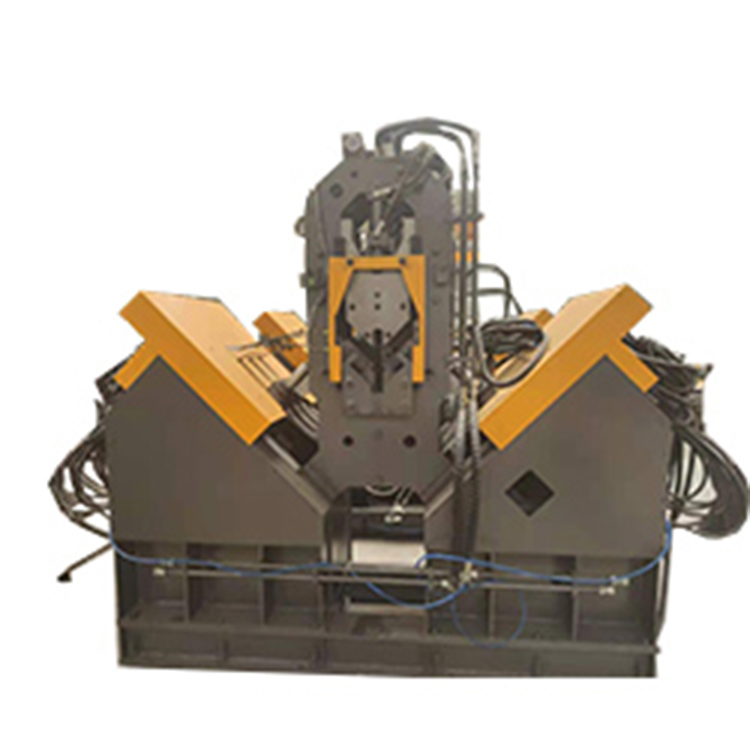
Integrated Processes: Efficiency comes from combining multiple steps. A single machine line can punch, shear, and mark parts in one continuous, automated sequence. This integration is embodied in the CNC angle punching shearing marking line.
Efficiency in the Marking Line
In complex lattice structures like transmission towers, every single piece of steel has a unique part number and orientation. Manual marking is slow, prone to errors, and can fade or be obscured. An automated marking system, integrated into the CNC line, solves this. It permanently stamps or scribes each part with its identifier as it's being processed. This seemingly small step has a massive downstream impact. It drastically reduces assembly errors in the field, saving enormous amounts of time and labor during the final construction phase. Correctly marked parts ensure that complex steel lattices fit together perfectly on the first try.
The Importance of Material Handling
For high-volume production, the speed of the CNC process itself is only one part of the equation. Getting raw material to the machine and finished parts away from it can become a major bottleneck. Specialized angle steel lines incorporate automated infeed and outfeed systems. These systems use conveyors, rollers, and loading tables to stage raw stock and clear completed parts without manual intervention. This allows the core angle steel punching shearing CNC machine to run continuously, maximizing throughput and overall facility efficiency.
Strategic Evaluation: Choosing the Right CNC System for Your Facility
Selecting a CNC machine is a significant capital investment that impacts productivity for years. Making the right choice requires moving beyond the sticker price and conducting a thorough strategic evaluation based on your specific operational needs.
Defining Your Success Criteria
Before you even look at machine specifications, you must define what success looks like for your application. This involves answering several key questions:
Tolerance Requirements: What level of precision do your parts demand? An aerospace component might require tolerances of +/- 0.0001 inches, necessitating a high-end, temperature-controlled machine. A structural steel bracket might be perfectly acceptable at +/- 0.005 inches, allowing for a more robust, less expensive machine.
Material Compatibility: What materials will you be cutting? For metals like aluminum or steel, traditional milling and turning are effective. However, for heat-sensitive materials, a process like laser or plasma cutting might create an undesirable Heat-Affected Zone (HAZ) that alters the material's properties. In such cases, a "cold-cutting" process like abrasive waterjet machining or mechanical shearing might be a better choice.
Scalability and the Software Ecosystem
A CNC machine is only as good as the software that runs it. A critical, and often overlooked, component is the "post-processor." This is a small but vital piece of software that translates the generic toolpath output from your CAM system into the specific G-code dialect that your particular machine controller understands. Before purchasing a machine, you must ensure that a reliable post-processor is available for your CAM software. Without it, your software can't "talk" to the hardware, rendering the machine useless. Inquiring about the availability and cost of post-processor development is a non-negotiable step.
Vendor Support and Interoperability
When a machine goes down, every minute of downtime costs money. The availability of prompt, expert technical support from the vendor is crucial. Consider the vendor's presence in your region. Can they have a technician on-site within 24 hours? Do they stock spare parts locally? Furthermore, consider the control system itself. Major controller brands like FANUC, Siemens, and Heidenhain have different strengths and user interfaces. If your facility already has operators trained on a specific controller, standardizing on that platform can significantly reduce the learning curve and improve operational flexibility. A vendor that offers multiple control options demonstrates a commitment to interoperability and customer choice.
Total Cost of Ownership (TCO) and ROI Drivers
The purchase price of a CNC machine is just the beginning of the story. A savvy decision-maker evaluates the Total Cost of Ownership (TCO), which encompasses all expenses over the machine's lifespan. Understanding these costs and the corresponding drivers of Return on Investment (ROI) provides a complete financial picture.
The "Hidden" Costs of CNC
Several significant expenses are not included in the initial quote but are essential for operation. Budgeting for them upfront prevents future financial surprises.
Tooling & Consumables: Cutting tools like end mills, drills, and inserts are wear items that need frequent replacement. The cost of high-performance tooling can be substantial. Additionally, consumables like cutting fluids (coolant), lubricants, and filters are recurring operational expenses.
Post-Processor Development: As mentioned, if a standard post-processor is not available for your specific machine/software combination, you may need to pay for custom development, which can cost thousands of dollars.
Metrology & Inspection: You must have a way to verify that the parts coming off the machine meet specifications. This requires investment in metrology equipment, such as calipers, micrometers, Coordinate Measuring Machines (CMMs), or laser scanners, as well as the labor to perform inspections.
Key ROI Drivers
While the costs are significant, the returns from strategic CNC implementation are even greater. The true ROI is found in operational efficiencies and quality improvements.
Reduction in Scrap: CNC precision dramatically reduces human error, leading to fewer rejected parts. Advanced CAM software also enables "nesting" optimization for sheet-based cutting, arranging parts on the raw material to minimize waste and maximize material yield.
Labor Shift, Not Elimination: CNC automation allows a single high-skilled programmer or setup person to oversee multiple machines simultaneously. The labor cost doesn't disappear; it shifts from numerous manual operators to fewer, more highly-trained technicians who add more value per hour.
Maximized Uptime: Advanced features like "in-cycle probing" contribute directly to uptime. A probe can automatically touch the workpiece to find its exact location, eliminating lengthy manual setup. It can also measure features mid-cycle to detect tool wear or defects in real-time, allowing for corrections before an entire batch of parts is ruined.
Implementation Risks and Future Trends
Integrating CNC technology successfully involves more than just purchasing hardware. It requires a strategic approach to managing risks and an awareness of future trends that are shaping the industry.
Navigating the Skills Gap
One of the most significant challenges in modern manufacturing is the skills gap. The transition from a manual machinist, who relies on "feel" and experience, to a CNC programmer, who thinks in terms of code and digital coordinates, is substantial. Companies must invest in continuous training and development for their workforce. This includes formal training on CAM software, controller operation, and G-code, as well as fostering a culture of digital literacy. Ignoring this human element is a common implementation mistake that can lead to underutilization of expensive equipment.
Industry 4.0 Integration and Predictive Maintenance
The future of CNC is connected. As part of the Industry 4.0 revolution, machines are increasingly being equipped with Internet of Things (IoT) sensors. These sensors monitor everything from spindle vibration and bearing temperature to coolant pressure. By collecting and analyzing this data, systems can predict when a component is likely to fail. This enables predictive maintenance, allowing service to be scheduled before a catastrophic breakdown occurs, minimizing unplanned downtime and maximizing productivity.
The Rise of AI and Real-Time Error Compensation
Artificial Intelligence (AI) is poised to make CNC machines even smarter. Future systems will use AI algorithms to make real-time adjustments during the machining process. For example, sensors could detect minute changes in machine temperature that cause thermal expansion, and the AI could instantly compensate the toolpath to maintain tolerance. Similarly, AI could monitor tool wear based on cutting forces and automatically adjust speeds and feeds or even call for a tool change to prevent part failure. This level of autonomous error compensation represents the next frontier in precision manufacturing.
Conclusion
Computer Numerical Control is far more than an acronym; it is the convergence of sophisticated software logic and powerful mechanical engineering. It represents a fundamental shift in how we transform digital designs into tangible, high-precision products. From the core workflow of CAD and CAM to the intricate mechanics of closed-loop systems, CNC technology is the engine of modern production. For decision-makers, the key is to look beyond the initial purchase price. Prioritize software compatibility, vendor support, and a comprehensive analysis of Total Cost of Ownership. The greatest returns are realized not just by buying a machine, but by integrating it as a strategic asset. The next step for any facility is to audit its current production bottlenecks. Identify where manual processes are slow, where errors are common, or where material waste is high. It is in these areas that specialized CNC automation offers the highest and most immediate impact.
FAQ
Q: What is the difference between NC and CNC?
A: NC (Numerical Control) used hard-wired logic and physical media like punched tape, making it difficult to change programs. CNC (Computer Numerical Control) uses a dedicated onboard computer, allowing programs to be easily created, edited, stored, and run from software. This makes CNC far more flexible and powerful.
Q: Can CNC machines work on any material?
A: CNC technology can be applied to a vast range of materials. This includes soft materials like plastics, wood, and composites, as well as metals from aluminum and brass to hardened tool steels used for durable components. The specific machine type and cutting tool are chosen based on the material's properties.
Q: What is G-code?
A: G-code is the primary programming language used to control CNC machines. It consists of alphanumeric commands that instruct the machine on positioning (where to move), motion type (how to move, e.g., straight line or arc), and specific parameters like feed rate and spindle speed. It is the standard language for defining toolpaths.
Q: How does a CNC angle punching shearing marking line improve efficiency?
A: It dramatically improves efficiency by combining three separate manufacturing processes into a single, continuous, automated workflow. Instead of handling a piece of steel three times for punching, shearing, and marking, the machine performs all operations in one pass. This reduces material handling, eliminates setup time between steps, and minimizes labor requirements.
Q: Is CNC machining better than 3D printing?
A: They are different tools for different jobs. CNC is a "subtractive" process that removes material from a solid block, which is generally faster and produces stronger parts for mass production. 3D printing is an "additive" process that builds a part layer by layer, which is ideal for complex geometries, rapid prototyping, and custom one-off parts.


