In structural steel fabrication, manual layout and legacy drilling methods are the primary bottlenecks for throughput and tolerance control. Relying on outdated manual techniques stunts business growth. It forces fabricators to waste countless hours on simple hole-making tasks. Scaling your production requires transitioning to modern automated systems. However, selecting the wrong machine type leads to high spindle downtime and excessive tooling wear. Poor equipment choices ultimately disrupt your entire fabrication workflow.
We provide a vendor-neutral, engineering-focused breakdown of the top five machine configurations available today. You will learn standard evaluation criteria to guide your procurement process. We also explain how to assess factory manufacturing capabilities carefully. This ensures you secure a highly reliable machine for your shop floor.
Key Takeaways
Machine selection must align strictly with your primary material dimensions, maximum hole diameters, and batch volumes.
Gantry-movable systems offer the highest flexibility for oversized plates, while fixed-bed systems excel in high-speed flange and tube sheet processing.
Total Cost of Ownership (TCO) is dictated as much by software integration and preventative maintenance as by the initial machine purchase price.
Evaluating the manufacturing standards of a cnc plate drilling machine factory is critical for long-term parts availability and technical support.
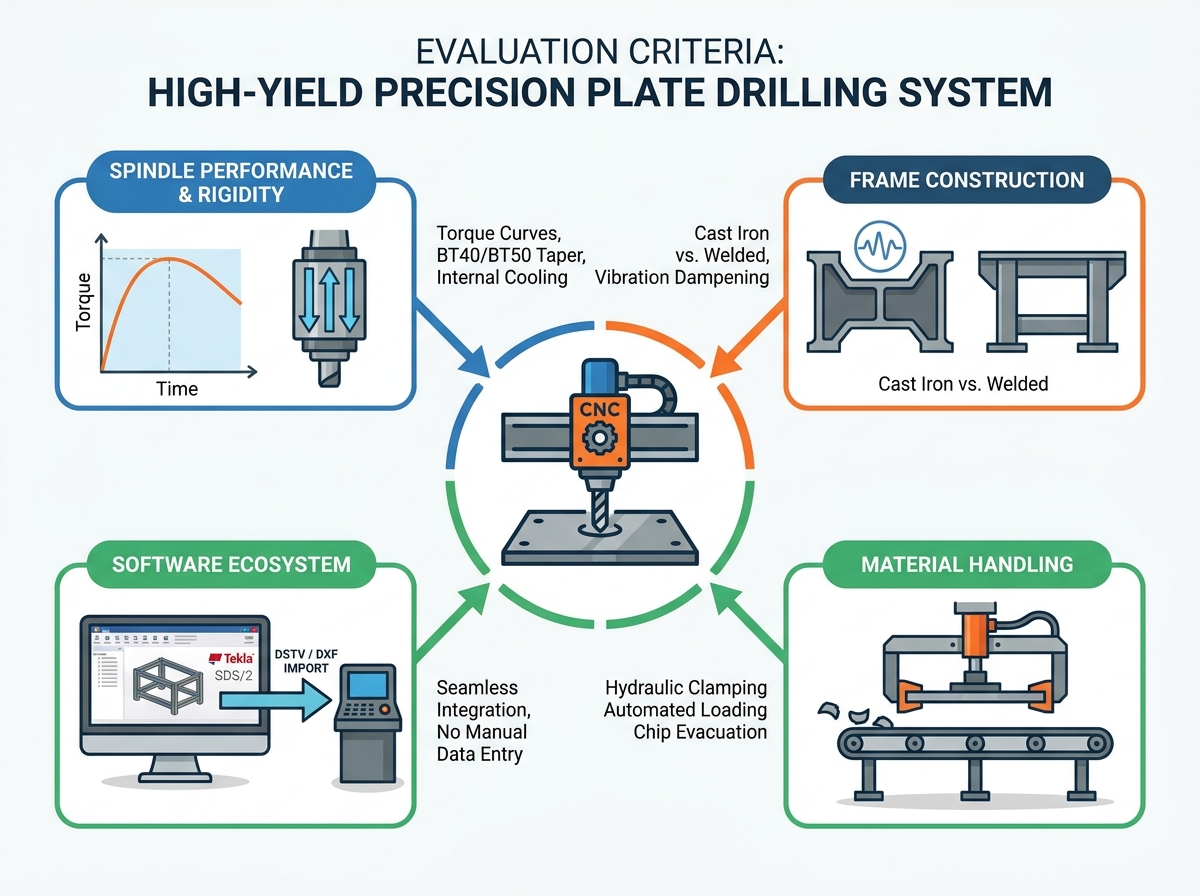
Evaluation Criteria: Defining a High-Yield Precision Plate Drilling System
Procuring a high-performing precision plate drilling system requires evaluating specific mechanical and digital traits. You must analyze the core components driving speed and accuracy. Do not rely solely on basic marketing brochures.
Spindle Performance & Rigidity
You must assess torque curves across the entire RPM range. Machines cutting large diameter holes require immense low-end torque. Spindle taper types dictate tooling stability. Standard BT40 or BT50 tapers securely lock heavy tools in place under extreme lateral loads. Internal cooling capabilities remain mandatory. High-pressure through-spindle coolant flushes chips out of deep holes rapidly. It also prevents carbide inserts from cracking under sudden thermal shock.
Frame Construction
Engineers analyze structural frame integrity using complex finite element analysis. Cast iron beds absorb machining vibrations significantly better than welded steel alternatives. Less vibration extends your tool life dramatically. It also keeps drilled holes perfectly round. Welded steel beds offer cost savings but often struggle to dampen the harmonics generated by heavy drilling operations.
The table below compares common machine frame constructions.
Construction Material
Vibration Dampening
Best Application
Cast Iron Bed
Excellent
High-tolerance aerospace components and structural flanges
Welded Steel Bed
Moderate
General fabrication and lighter gauge plate processing
Composite Polymer
Superior
Ultra-precision micro-machining environments
Software Ecosystem
Modern steel detailing software eliminates manual data entry entirely. Programs like Tekla Structures and SDS/2 export DSTV or DXF files seamlessly. Your machine controller reads these files directly. This digital handover transfers hole locations, plate contours, and part numbers instantly. It prevents operators from entering incorrect X-Y coordinates manually. Direct integration minimizes scrap rates and accelerates setup times.
Material Handling
Efficient material handling keeps the spindle running continuously. Hydraulic clamping systems hold parts rigid during aggressive drilling. Independent vertical clamping cylinders flatten warped plates against the datum surface effectively. Chip evacuation conveyors remove metal debris automatically. Automated loading and unloading sequences reduce idle time between part changeovers. Efficient handling turns a good machine into a high-yield production center.
Top 5 CNC Plate Drilling Machine Configurations for Steel Fabricators
We categorized these machines by industrial application and operational architecture. This structure guides direct procurement matching based on your specific shop layout.
1. The High-Speed Gantry Movable Drilling Equipment
Best For: Oversized, heavy steel plates used heavily in bridge construction and large structural components.
Technical Advantage: The workpiece remains entirely stationary. The gantry travels dynamically over the material. This architecture saves massive amounts of floor space. It also reduces material handling risks associated with moving multi-ton plates.
Decision Lens: You must check the axis drive mechanisms closely. Look for dual servo-motors driving both sides of the gantry. Dual motors ensure perfect synchronization. Single motors often struggle and skew over long travel distances. A robust gantry movable drilling equipment setup guarantees accuracy on massive structural elements.
2. Heavy-Duty Multi-Spindle CNC Plate Drill
Best For: High-volume batch production involving standard connecting plates, base plates, and gussets.
Technical Advantage: Multiple spindles engage the material at once. Simultaneous drilling operations reduce cycle times drastically. You can process multiple stacked sheets simultaneously to maximize sheet yield.
Decision Lens: You must assess spindle center-distance adjustability. Verify the maximum hydraulic clamping pressure limits. You need exceptionally strong clamps to hold heavily stacked plates securely during multi-tool engagement.
3. Compact Fixed-Bed / Moving Workpiece Machine
Best For: Thick structural flanges, heat exchanger tube sheets, and smaller heavy-duty fittings.
Technical Advantage: These machines feature a stationary spindle bridge. This fixed bridge provides exceptional rigidity and precision. The lack of moving bridge mass eliminates deflection under heavy Z-axis thrust loads.
Decision Lens: Evaluate the maximum payload capacity of the CNC feeding table. The table moves the material under the spindle. It must handle your heaviest typical stock without stalling the servo drives.
4. The Hybrid High-Speed Plate Drilling Machine (Drill + Mill)
Best For: Fabricators requiring light milling, tapping, and countersinking alongside standard hole-making.
Technical Advantage: This configuration eliminates secondary machining operations. You keep the part secured on a single machine center. Operators never move the plate to a separate milling station.
Best For: Thin-to-medium gauge steel plates requiring rapid hole generation where standard punching tolerances are acceptable.
Technical Advantage: It blends the sheer speed of hydraulic punching with the strict precision of CNC drilling. You drill the thicker localized areas to prevent distortion. You punch the thinner sections rapidly.
Decision Lens: Assess the tooling changeover times carefully. Ensure the software automatically selects between punch and drill tools correctly. Material thickness always dictates the proper hole-making method.
Sourcing Security: How to Vet a CNC Plate Drilling Machine Factory
Partnering with a proven cnc plate drilling machine factory minimizes ongoing operational risks. You must audit their internal manufacturing standards before signing purchase orders.
Factory Acceptance Testing (FAT): Demand a live machining run before shipment. Use your specific DSTV files. Test your exact material grades. Never accept equipment before successful FAT completion. This proves the machine performs exactly as advertised.
Component Sourcing: Verify where critical wear parts originate. Examine the linear guides, ball screws, servo drives, and spindle bearings. Standardized brands like THK, Siemens, or Fanuc reduce downtime. Proprietary components force you into long wait times for overseas shipping.
In-House Machining Capabilities: Look closely at their production methods. Credible manufacturers utilize massive 5-axis machining centers. They mill their own machine beds in-house. This internal control guarantees fundamental geometric accuracy across the entire frame.
After-Sales Infrastructure: Review the Service Level Agreement (SLA) thoroughly. Remote software diagnostics save days of manual troubleshooting. Fast technician dispatch times keep your production schedule intact. A robust domestic spare parts inventory remains absolutely non-negotiable.
Implementation Realities of Industrial Steel Plate Machinery
Installing sophisticated industrial steel plate machinery demands careful facility preparation. You must plan for physical and operational transitions.
Heavy-duty machines often require specialized concrete foundation pouring. You must install isolation joints to prevent surrounding equipment vibrations from reaching the drill bed. Specific power grids and dedicated air supply lines are mandatory. You need to factor these facility upgrades into your initial installation timeline.
Transitioning from manual layout to CNC operations involves a steep operator adoption curve. Modern controllers automatically generate toolpaths from 3D models. However, operators still need time to master the new user interface. Factor in one or two weeks of slower production during the onboarding and software integration phase. Comprehensive training ensures your team utilizes all advanced features safely.
High-speed operations mandate premium consumables. You must use high-quality through-coolant carbide drills. Budgeting adequately for advanced tooling ensures you realize the machine's advertised feed rates. Standard high-speed steel (HSS) drill bits simply cannot handle the RPMs generated by these modern spindles. Proper tooling prevents frequent bit snapping and surface marring.
Conclusion
Selecting the right machine requires balancing plate dimensions against required throughput. You must weigh available floor space against the specific architecture of the equipment. Gantry models fit massive jobs, while fixed-bed units handle smaller, thicker parts perfectly. Choosing the correct configuration prevents bottlenecks and extends equipment lifespan.
Audit your current production bottlenecks today. Aggregate your most common plate sizes and note your maximum required hole diameters. Prepare a few sample test files exported from your detailing software.
Request a technical consultation immediately. Send your sample CAD files to a qualified manufacturer. Secure a verifiable cycle-time estimate before making any final procurement decisions.
FAQ
Q: What is the maximum plate thickness a standard CNC plate drill can handle?
A: Most standard configurations easily handle plates ranging from 50mm to 150mm thick. Your absolute maximum thickness depends heavily on spindle horsepower and tooling types. Machines running large U-drills require significantly more torque than those using standard twist drills. Always verify spindle specifications against your thickest typical stock.
Q: Can these machines perform tapping and countersinking?
A: Yes, hybrid models handle these operations flawlessly. Basic drill-only machines often lack the low-RPM torque necessary for rigid tapping. Advanced setups feature multi-tool Automatic Tool Changer (ATC) carousels. They automatically swap tools to tap threads or countersink holes in a single setup without manual intervention.
Q: How do you load and unload heavy plates on a gantry movable machine?
A: Operators typically use overhead bridge cranes equipped with powerful magnetic lifters or vacuum pads. Many modern facilities integrate automated roller conveyors to feed material directly onto the cutting bed. This eliminates manual lifting hazards and drastically speeds up the entire material handling process.
Q: Does the machine software integrate with Tekla Structures?
A: Yes, modern drilling software integrates seamlessly. The industry standard utilizes direct DSTV file reading. You export files from your 3D structural model directly into the machine control software. This digital workflow completely eliminates manual MDI data input and prevents costly layout errors.