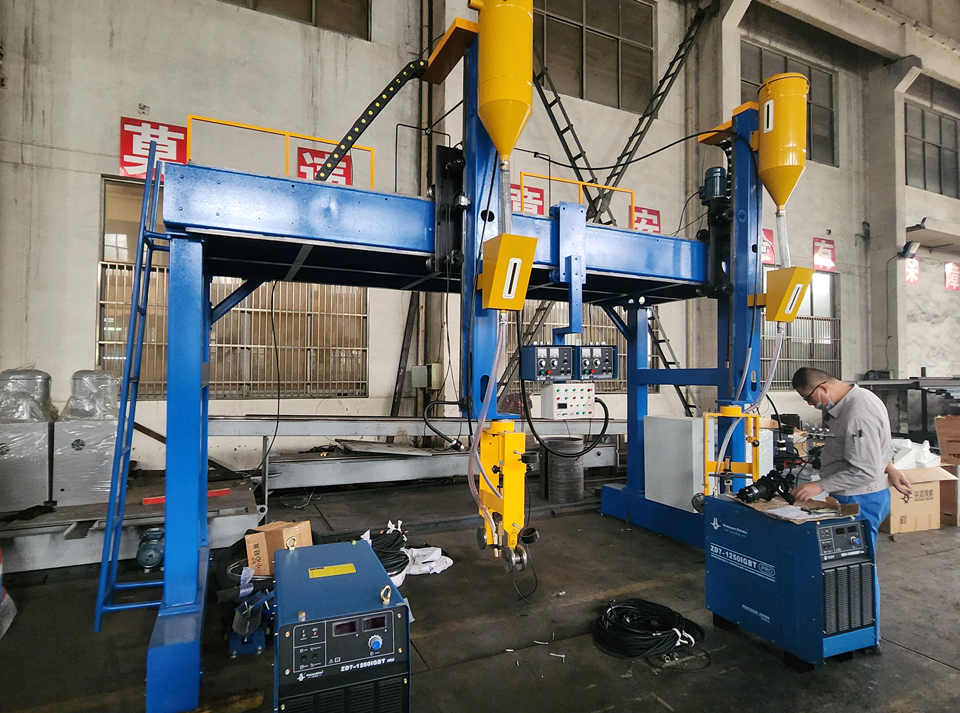
CNC H-beam Welding Line for Steel Structure - Automated Fabrication Solution for H/I/T Beams
The FDZA CNC H-Beam Welding Production Line is a fully automated turnkey system designed for high-efficiency fabrication of structural steel members. It integrates precision positioning, dual-side synchronous welding, and post-weld correction to deliver 40% faster production with ASTM/AISC-compliant weld quality.
- Four-head dual-side synchronous welding reduces thermal distortion by 70% - Processes web heights 300-3000mm and flange widths 200-1250mm - Integrated workflow cuts production steps from 5 to 3 - AC+DC double-wire technology ensures consistent weld penetration with real-time parameter tracking
The FDZA CNC H-Beam Welding Production Line functions as a complete, turnkey automation system dedicated to H-beam, I-beam, and T-beam fabrication. Engineered to handle the entire lifecycle of structural steel production, this system integrates material positioning, precision assembly, synchronous welding, post-weld flange correction, and automated painting preparations into a single, cohesive workflow. By transforming raw steel plates into finished, load-bearing structural members with exacting weld consistency, the line reduces overall production time by 40% compared to manual welding methods, effectively eliminating labor-dependent variability.
Backed by international CE, ISO 9001, and SGS certifications, the equipment guarantees that all fabricated steel components strictly comply with ASTM/AISC construction standards. From the heavy-duty steel frame construction to the precise control of the welding arc, every component is designed for continuous, heavy-industrial operation.
Thermal Control: Dual-side synchronous welding reduces thermal distortion by 70% versus traditional single-side welding.
Dimensional Flexibility: Handles web heights ranging from 300mm to 3000mm, and flange widths from 200mm to 1250mm.
Process Consolidation: Integrates assembly and welding into 3 steps (down from 5 for traditional lines), drastically cutting lead times.
The defining operational advantage of this welding line is its capacity to execute simultaneous welding on both flanges of an H-beam using a synchronized four-head welding system—allocating two heads per side. This symmetrical heat application creates a balanced thermal load across the steel, actively preventing the warping and bending typically associated with single-side passes. By neutralizing these stresses, the system reduces post-weld mechanical correction requirements by up to 70%. The equipment employs an advanced double wire (AC+DC) submerged arc process that generates a stable, deeply penetrating molten pool, leaving a smooth, spatter-free weld bead that requires zero manual grinding.
Wide Processing Capacity & Flexible Customization
Engineered for maximum facility versatility, the welding line accommodates a massive spectrum of beam dimensions. It routinely processes web heights from 300mm to 3000mm, flange widths from 200mm to 1250mm, and raw material thicknesses ranging from 5mm to 50mm. In its standard configuration, the system handles beam lengths up to 12 meters. Recognizing that no two fabrication floors are identical, the system supports comprehensive OEM/ODM customization. Factory layouts, specific conveyor lengths, and non-standard heavy-duty capacity requirements can be engineered to order, allowing fabricators to produce everything from compact secondary supports to massive primary structural members on a single line.
Integrated Assembly and Welding
Traditional fabrication requires moving heavy steel between separate tacking, assembling, and welding stations. This line utilizes an integrated architecture that combines positioning and welding within a single, continuous station. Operators can hear the audible hum of precision servo-driven rollers as they guide the web and flange plates into position, achieving a strict ±0.5mm alignment accuracy. Simultaneously, the solid mechanical grip of the hydraulic clamping system locks the components firmly in place during the arc ignition. This consolidated approach condenses the workflow from five steps down to three, slicing total production time by approximately 40% and drastically reducing overhead crane usage.
Advanced Process Control & Digital MES Integration
Command over the entire production cycle is centralized in an industrial-grade PLC system, accessed via a highly responsive 15-inch touchscreen interface. The software archives specific welding parameters based on material grades and plate thicknesses, ensuring repeatable penetration profiles across multiple shifts. Moving toward Industry 4.0 standards, the control unit supports direct integration with existing Manufacturing Execution Systems (MES). This allows plant managers to pull real-time data on welding current, voltage, and travel speed directly to their dashboards. If material fit-up varies, the system automatically adjusts parameters on the fly. Following the weld, an eccentric roller system corrects any residual angular deformation while the steel remains hot, conserving electrical energy and improving final dimensional accuracy.
Industrial Safety & Environmental Protection
Heavy steel fabrication inherently produces hazards, which this system actively mitigates through comprehensive safety engineering. The primary welding zones are enclosed within protective stations that shield surrounding workers from intense arc flash and radiant heat. To address air quality, the line integrates a high-capacity welding fume extraction and purification system that captures particulate matter directly at the source, resulting in a noticeably cleaner shop environment that meets strict environmental emissions standards. Additionally, integrated anti-backfire devices and emergency stop interlocks provide physical security for operators during continuous production runs.
Applications
Commercial and Industrial Construction
The primary deployment for the CNC H-beam Welding Line involves manufacturing heavy structural frameworks for high-rise buildings, sprawling industrial warehouses, and large-scale manufacturing facilities. The exacting dimensional accuracy and verified weld penetration ensure that these beams can confidently support immense dead and live loads over extended spans, satisfying the rigorous safety inspections required in commercial real estate development.
Infrastructure Projects
Within the civil engineering sector, the equipment is utilized to fabricate critical load-bearing H-beams for bridge structures, highway overpasses, and massive transportation hubs. Public infrastructure demands decades of reliable performance under constant vibration and dynamic loading; the precise, defect-free welds produced by this automated line are essential for preventing metal fatigue and ensuring long-term public safety.
Heavy Machinery Manufacturing
The system supplies highly accurate steel members used in the construction of crane structures, heavy material handling equipment, and rigid industrial machinery frames. Because the line minimizes thermal distortion and corrects flanges in real-time, the resulting beams exhibit exceptional straightness. This dimensional fidelity guarantees the proper alignment of mechanical rails and moving parts, ultimately reducing friction and premature wear on the final machinery.
Offshore and Energy Structures
Fabricators serving the energy sector rely on this equipment to build wind turbine support structures, power plant frameworks, and components for offshore drilling platforms. These environments subject steel to extreme saline corrosion, gale-force winds, and freezing temperatures. The line’s ability to execute flawless, full-penetration welds on high-yield steel ensures the structural integrity required to survive harsh marine and industrial environments where maintenance is exceptionally difficult.
FAQ
What welding processes does the system utilize?
The core welding mechanism relies on a double wire submerged arc welding (SAW) process, powered by a combination of AC and DC sources. This specific configuration yields exceptionally high deposition rates—reaching up to 15 kg/h per wire—while offering superior gap-bridging capabilities when compared to standard single-wire setups. Should your fabrication require it, the line can be customized with supplementary gas metal arc welding (GMAW) stations for specialized joint configurations.
What is the production capacity of the welding line?
Depending on the thickness of the steel plates and the specified weld fillet size, the system maintains a continuous welding speed ranging from 0.5 to 3 m/min. Over the course of a standard 8-hour operating shift, the line is capable of producing between 40–60 metric tons of fully finished H-beams. This output represents a 300% increase in overall productivity when measured against conventional manual welding and assembly operations.
How long does it take to change over between different beam sizes?
The integrated CNC architecture facilitates rapid, tool-less changeovers between varying beam profiles. For major dimensional changes, complete setup times typically range from 15 to 30 minutes. The operator inputs the new dimensions into the HMI, and the system automatically adjusts the motorized guide rollers, hydraulic clamping pressures, and electrical welding parameters without requiring operators to perform manual mechanical unbolting.
What material types can be processed?
The machinery is specifically optimized for standard carbon structural steels (such as ASTM A36 and S235) as well as high-strength low-alloy steels (including ASTM A572 and S355). By selecting the appropriate pre-programmed parameters on the control interface, the line easily processes specialized weathering steels (ASTM A588) and complex quenched-and-tempered steels boasting up to a 690 MPa yield strength.
What quality control features are included?
Quality assurance is built directly into the production cycle. The system performs continuous in-process monitoring of all arc parameters, logging the data in real-time. It supports integration with ultrasonic testing (UT) equipment to verify internal weld integrity, alongside automated dimensional measurement tools that constantly verify flange parallelism and web perpendicularity. All captured data can be exported to generate compliance documentation for inspectors.
What kind of lifecycle support and warranty do you provide?
We deliver comprehensive, end-to-end lifecycle support for every installation. This includes dispatching engineers globally for on-site installation, commissioning, and hands-on operator training. The entire production line is backed by a 2-year extended warranty. Furthermore, we maintain a rapid-response global spare parts inventory, ensuring that consumable components and critical replacement parts are shipped immediately to minimize any potential facility downtime.
Product Overview
The FDZA CNC H-Beam Welding Production Line functions as a complete, turnkey automation system dedicated to H-beam, I-beam, and T-beam fabrication. Engineered to handle the entire lifecycle of structural steel production, this system integrates material positioning, precision assembly, synchronous welding, post-weld flange correction, and automated painting preparations into a single, cohesive workflow. By transforming raw steel plates into finished, load-bearing structural members with exacting weld consistency, the line reduces overall production time by 40% compared to manual welding methods, effectively eliminating labor-dependent variability. Plant managers can clearly calculate their return on investment through immediate reductions in manual labor overhead and minimized consumable waste.
Backed by international CE, ISO 9001, and SGS certifications, the equipment guarantees that all fabricated steel components strictly comply with ASTM/AISC construction standards. From the heavy-duty steel frame construction that absorbs operational vibrations to the precise control of the welding arc, every component is designed for continuous, heavy-industrial operation. The physical footprint of the machinery is optimized for efficient material flow, ensuring raw steel moves logically from the loading bay to the final inspection rack.
Thermal Control: Dual-side synchronous welding reduces thermal distortion by 70% versus traditional single-side welding.
Dimensional Flexibility: Handles web heights ranging from 300mm to 3000mm, and flange widths from 200mm to 1250mm.
Process Consolidation: Integrates assembly and welding into 3 steps (down from 5 for traditional lines), drastically cutting lead times.
The defining operational advantage of this welding line is its capacity to execute simultaneous welding on both flanges of an H-beam using a synchronized four-head welding system—allocating two heads per side. This symmetrical heat application creates a balanced thermal load across the steel, actively preventing the warping and bending typically associated with single-side passes. By neutralizing these stresses, the system reduces post-weld mechanical correction requirements by up to 70%. The equipment employs an advanced double wire (AC+DC) submerged arc process that generates a stable, deeply penetrating molten pool, leaving a smooth, spatter-free weld bead that requires zero manual grinding. Operators can visually confirm the exceptionally clean metallic finish immediately after the flux is cleared.
Wide Processing Capacity & Flexible Customization
Engineered for maximum facility versatility, the welding line accommodates a massive spectrum of beam dimensions. It routinely processes web heights from 300mm to 3000mm, flange widths from 200mm to 1250mm, and raw material thicknesses ranging from 5mm to 50mm. In its standard configuration, the system handles beam lengths up to 12 meters. Recognizing that no two fabrication floors are identical, our senior engineering team supports comprehensive OEM/ODM customization. We provide complete visual layout drafts and dynamic flow planning based on your exact factory dimensions. Factory layouts, specific conveyor lengths, and non-standard heavy-duty capacity requirements can be engineered to order, allowing fabricators to produce everything from compact secondary supports to massive primary structural members on a single turnkey line.
Integrated Assembly and Welding
Traditional fabrication requires moving heavy steel between separate tacking, assembling, and welding stations. This line utilizes an integrated architecture that combines positioning and welding within a single, continuous station. Operators can hear the audible hum of precision servo-driven rollers as they guide the web and flange plates into position, achieving a strict ±0.5mm alignment accuracy. Simultaneously, the solid mechanical grip of the hydraulic clamping system locks the components firmly in place during the arc ignition. This consolidated approach condenses the workflow from five steps down to three, slicing total production time by approximately 40% and drastically reducing overhead crane usage, which directly translates to lower daily operating costs.
Advanced Process Control & Digital MES Integration
Command over the entire production cycle is centralized in an industrial-grade PLC system, accessed via a highly responsive 15-inch touchscreen interface that provides immediate tactile feedback. The software archives specific welding parameters based on material grades and plate thicknesses, ensuring repeatable penetration profiles across multiple shifts. Moving toward modern data-driven manufacturing standards, the control unit supports direct integration with existing Manufacturing Execution Systems (MES). This allows plant managers to pull real-time data on welding current, voltage, and travel speed directly to their dashboards, optimizing energy consumption and tracking precise production metrics. Following the weld, an eccentric roller system corrects any residual angular deformation while the steel remains hot, conserving electrical energy and improving final dimensional accuracy.
Industrial Safety & Environmental Protection
Heavy steel fabrication inherently produces hazards, which this system actively mitigates through comprehensive safety engineering. The primary welding zones are enclosed within protective stations that shield surrounding workers from intense arc flash and radiant heat. To address air quality, the line integrates a high-capacity welding fume extraction and purification system. The distinct scent of heated metal and flux is captured directly at the source, resulting in a noticeably cleaner shop environment that meets strict environmental emissions standards. Additionally, integrated anti-backfire devices and emergency stop interlocks provide physical security for operators during continuous production runs, preventing costly workplace incidents.
Applications
Commercial and Industrial Construction
The primary deployment for the CNC H-beam Welding Line involves manufacturing heavy structural frameworks for high-rise buildings, sprawling industrial warehouses, and large-scale manufacturing facilities. Real-world application data from global steel structure plants confirms that the exacting dimensional accuracy and verified weld penetration ensure these beams confidently support immense dead and live loads over extended spans, easily satisfying the rigorous safety inspections required in commercial real estate development.
Infrastructure Projects
Within the civil engineering sector, the equipment is utilized to fabricate critical load-bearing H-beams for bridge structures, highway overpasses, and massive transportation hubs. Public infrastructure demands decades of reliable performance under constant vibration and dynamic loading. Field deployments in major municipal projects demonstrate that the precise, defect-free welds produced by this automated line are essential for preventing metal fatigue and ensuring long-term public safety under heavy traffic conditions.
Heavy Machinery Manufacturing
The system supplies highly accurate steel members used in the construction of crane structures, heavy material handling equipment, and rigid industrial machinery frames. Because the line minimizes thermal distortion and corrects flanges in real-time, the resulting beams exhibit exceptional straightness. This dimensional fidelity guarantees the proper alignment of mechanical rails and moving parts, ultimately reducing friction and premature wear on the final machinery, as verified by leading heavy equipment manufacturers.
Offshore and Energy Structures
Fabricators serving the energy sector rely on this equipment to build wind turbine support structures, power plant frameworks, and components for offshore drilling platforms. These environments subject steel to extreme saline corrosion, gale-force winds, and freezing temperatures. The line’s proven ability to execute flawless, full-penetration welds on high-yield steel ensures the structural integrity required to survive harsh marine and industrial environments where physical maintenance is exceptionally difficult and costly.
FAQ
What welding processes does the system utilize?
The core welding mechanism relies on a double wire submerged arc welding (SAW) process, powered by a combination of AC and DC sources. This specific configuration yields exceptionally high deposition rates—reaching up to 15 kg/h per wire—while offering superior gap-bridging capabilities when compared to standard single-wire setups. Should your fabrication require it, the line can be customized with supplementary gas metal arc welding (GMAW) stations for specialized joint configurations.
What is the production capacity of the welding line?
Depending on the thickness of the steel plates and the specified weld fillet size, the system maintains a continuous welding speed ranging from 0.5 to 3 m/min. Over the course of a standard 8-hour operating shift, the line is capable of producing between 40–60 metric tons of fully finished H-beams. This output represents a 300% increase in overall productivity when measured against conventional manual welding and assembly operations.
How long does it take to change over between different beam sizes?
The integrated CNC architecture facilitates rapid, tool-less changeovers between varying beam profiles. For major dimensional changes, complete setup times typically range from 15 to 30 minutes. The operator inputs the new dimensions into the HMI, and the system automatically adjusts the motorized guide rollers, hydraulic clamping pressures, and electrical welding parameters without requiring operators to perform manual mechanical unbolting.
What material types can be processed?
The machinery is specifically optimized for standard carbon structural steels (such as ASTM A36 and S235) as well as high-strength low-alloy steels (including ASTM A572 and S355). By selecting the appropriate pre-programmed parameters on the control interface, the line easily processes specialized weathering steels (ASTM A588) and complex quenched-and-tempered steels boasting up to a 690 MPa yield strength.
What quality control features are included?
Quality assurance is built directly into the production cycle. The system performs continuous in-process monitoring of all arc parameters, logging the data in real-time. It supports integration with ultrasonic testing (UT) equipment to verify internal weld integrity, alongside automated dimensional measurement tools that constantly verify flange parallelism and web perpendicularity. All captured data can be exported to generate compliance documentation for inspectors.
How is the equipment packaged and transported globally?
Given the massive scale and weight of this industrial equipment, we implement strict industrial-grade anti-rust and anti-collision packaging protocols. Critical components are secured within reinforced steel frames and sealed in heavy-duty moisture-barrier wrapping to prevent oxidation during extended maritime transit. Our logistics team provides comprehensive cross-border shipping coordination and detailed customs clearance guidance, ensuring your machinery arrives at the facility safely and on schedule.
What kind of lifecycle support and warranty do you provide?
We deliver comprehensive, end-to-end lifecycle support for every installation to ensure your factory transitions smoothly into full production. This includes dispatching engineers globally for on-site installation, system calibration, and hands-on operator training. The entire production line is backed by a 2-year extended warranty. Furthermore, we maintain a rapid-response global spare parts inventory and offer 7x24 remote technical troubleshooting, ensuring that consumable components and critical replacement parts are shipped immediately to minimize any potential facility downtime.