In steel tower production for transmission and telecom sectors, field assembly bottlenecks often trace back to fabrication inaccuracies. A single misplaced hole halts an entire erection crew. Upgrading to a modern steel tower fabrication machine represents a substantial capital expenditure. You are not just acquiring steel-cutting hardware. You are securing a reliable production pipeline to meet strict project deadlines. It remains essential to look beyond basic sales brochures. You must scrutinize the engineering principles backing each equipment model. This article provides a structured evaluation framework for assessing hardware options. We explore crucial technical specifications, software integration capabilities, and vendor reliability indicators. By the end, you will understand exactly how to shortlist machines. You will learn to prioritize measurable operational outcomes over generic marketing claims.
Key Takeaways
Tolerance dictates ROI: Precision CNC processing eliminates costly on-site rework and mismatched bolt holes during tower erection.
Software is as critical as hardware: Seamless integration with detailing software (e.g., Tekla Structures) directly impacts scrap rates and throughput.
Look beyond the purchase price: Total Cost of Ownership (TCO) relies heavily on the cnc angle punching machine manufacturer’s after-sales support, spare parts availability, and training programs.
Match capacity to reality: Over-specifying drives up costs; under-specifying leads to machine fatigue and accelerated tooling wear.
Defining Success Criteria for Steel Tower Fabrication
Evaluating equipment requires clear success metrics. You must define acceptable performance levels clearly. These metrics guide your entire purchasing strategy. They prevent emotional or purely budget-driven decisions.
The Fit-Up Mandate
Lattice towers rely intensely on precise bolted connections. Construction crews assemble these heavy structures hundreds of feet above ground. A misaligned bolt hole drastically reduces erection speed. It also forces workers into dangerous on-site modifications. Utilizing an automated angle processing system ensures strict dimensional tolerances. Accurate punching guarantees structural integrity under severe wind loads. Precision machining prevents forced fit-ups. Forced fit-ups introduce immense internal stresses into the steel framework. This ultimately compromises the entire tower infrastructure. Tolerance stack-up presents a massive risk. A one-millimeter error across ten consecutive joints creates a massive structural deviation. High-quality machinery eliminates this cumulative error entirely. You secure perfect alignment across every diagonal bracing member.
Scrap Reduction Metrics
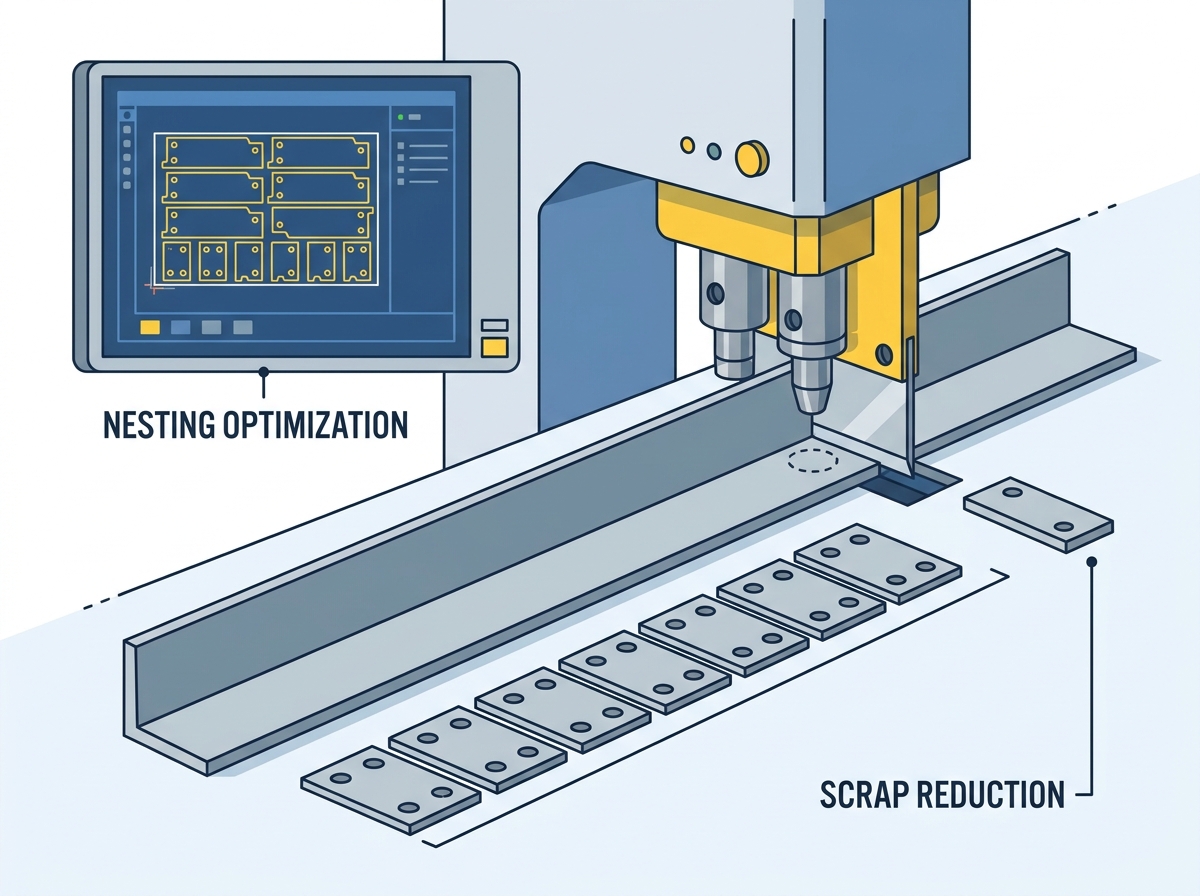
Steel material costs dominate tower fabrication budgets. Reducing scrap directly improves your profit margins. Advanced nesting algorithms analyze standard angle stock lengths. They determine the most mathematically efficient cutting patterns. An efficient machine minimizes useless offcut sections. You should measure operational success by yield percentage. Achieving a 95% material yield represents a strong industry benchmark. High waste indicates poor software synchronization. It might also expose hardware limitations during short-length processing. Every wasted meter of raw steel erodes your bottom line. Look closely at the material clamping mechanism. Some machines leave excessive dead zones near the end of a bar. Better grip designs maximize usable material lengths effectively.
Throughput Consistency
Many equipment vendors advertise theoretical maximum feed speeds. These peak numbers rarely reflect daily factory reality. You must focus heavily on throughput consistency instead. A reliable machine runs predictably across continuous multi-shift operations. Unplanned downtime destroys carefully planned production schedules. Evaluate the mean time between failures (MTBF) rigorously. A true high-speed angle line maintains momentum without overheating components. Measure how many tons of angle iron the system processes weekly. Consistent daily output outweighs brief bursts of speed. Consider the infeed and outfeed logistics. Fast punching means nothing if loading raw materials takes too long. Automated material handling conveyors dictate your actual factory throughput.
Core Technical Specifications to Evaluate
Hardware capabilities dictate your processing limits. You must understand specific mechanical thresholds. These details reveal the true capability of the machine.
Processing Capacity Range
You must align equipment specifications directly against your actual workload. Standard transmission towers require highly diverse angle profiles. Most production involves sizes ranging from L40x40x4mm up to heavy L200x200x20mm dimensions. High-voltage structures increasingly demand high-tensile steel grades. Materials like Q235, Q345, and Q420 behave differently under immense pressure. Higher yield strengths resist the punching tools aggressively. You need sufficient hydraulic power to penetrate thicker flanges cleanly. Over-specifying your machine inflates initial capital expenditure unnecessarily. Under-specifying leads to premature mechanical failure. Analyze your historical production data thoroughly. Choose a capacity range covering 90% of your typical project requirements. Subcontract the rare oversized components to specialized shops. This strategy optimizes your equipment utilization rate.
Punching Force and Station Layout
Hydraulic cylinder tonnage determines absolute piercing capability. A higher tonnage translates to cleaner holes in thick materials. Clean cuts prevent dangerous micro-fractures around the bolt holes. You must carefully assess the punching station layout. Single-station setups require frequent manual tool changes. This interrupts your workflow and hurts operator productivity. Multi-station setups offer a clear operational advantage. They house multiple die diameters simultaneously on each flange. Operators process complex parts without stopping the main drive. This dramatically accelerates production cycles. The die clearance must match the steel thickness precisely. Incorrect clearance causes severe material deformation.
Shearing and Marking Units
Cutting angle steel requires robust shearing technology. Single-cut shears slice through the profile in one motion. Double-cut shears remove a small section of material between cuts. Double-cut technology prevents distortion on the cut ends. This ensures perfect mating surfaces during tower assembly. You also need a dependable marking unit. Character stamping remains vital for tracking parts. Erection crews rely on clear part numbers to assemble towers correctly. CNC marking units imprint characters deeply into the steel. Paint can fade, but stamped numbers survive harsh weather conditions. Ensure the marking station applies sufficient pressure for legibility.
Feature Category
Basic Specification
Advanced Specification
Punching Stations
Single die per flange
Multiple dies per flange
Shearing Method
Single-blade cut
Double-blade cut (distortion-free)
Material Handling
Manual loading racks
Fully automated transverse conveyors
Marking System
Manual dial setup
CNC controlled cassette system
Evaluating Software and Systems Integration
Software drives modern manufacturing floors today. Hardware provides the physical muscle. Software acts as the coordinating brain. You must verify integration capabilities thoroughly before buying.
Detailing Software Compatibility
The machine controller must read industry-standard file formats seamlessly. Detailing software like Tekla Structures generates DSTV or NC1 files. The control system must interpret these files perfectly. It should not require any manual data entry from operators. Manual entry introduces dangerous human error into the process. It also slows down the production pipeline drastically. Verify the translation accuracy during vendor demonstrations. Send your own complex part files to the vendor. Demand proof of successful file conversion.
Real-Time Monitoring and ERP Handshakes
Look closely for real-time monitoring features. Operators need immediate feedback on machine status. Diagnostic software identifies sensor faults before they cause severe damage. Predictive maintenance alerts prevent unexpected mechanical breakdowns. Integration into your broader ERP system adds massive value. It allows factory management to track material consumption accurately. It also tracks individual operator efficiency automatically. The best control systems provide remote troubleshooting capabilities. Technicians can access the machine virtually over secure networks. They resolve software glitches fast without traveling to your facility.
Assessing Vendor Reliability and After-Sales Support
A machine performs only as well as its support team. You are forming a long-term partnership. Hardware will eventually require replacement parts. Tooling wears down over continuous heavy shifts.
Spare Parts Inventory Strategy
You need a vendor guaranteeing rapid part dispatch. Assess their global and local service network carefully. Ask direct questions about guaranteed response times. Find out where they stock critical hydraulic components. Overseas shipping delays can paralyze your production floor. A reliable partner maintains regional parts warehouses. Ask for a list of locally stocked consumable items. Punches, dies, and shear blades must be readily available.
Training and Installation Programs
Consider the comprehensiveness of operational training programs. Operating a CNC angle punching line demands specific technical skills. Poorly trained operators will damage expensive tooling quickly. They will also fail to optimize the nesting software. A reliable vendor provides rigorous on-site training sessions. They also supply detailed translated maintenance manuals. Check their track record strictly within the steel tower industry. Request references from similar lattice tower fabrication facilities. Speak directly to past clients. Inquire about actual responses to emergency breakdowns.
Best Practices for Installation and Maintenance
Proper installation sets the foundation for machine longevity. Even the best equipment fails if poorly maintained. Follow strict protocols to ensure continuous operational excellence.
Foundation and Environmental Requirements
You must prepare a solid concrete foundation. Vibrations from heavy punching forces misalign the machine over time. Consult the foundation drawings months before delivery. Ensure your facility possesses adequate power stability. Voltage fluctuations wreak absolute havoc on sensitive CNC electronics. Install dedicated voltage stabilizers if your grid is unreliable. Maintain a clean operating environment. Excessive steel dust damages linear guides and ball screws.
Best Practices for Optimal Performance
Implement a strict daily lubrication schedule for all moving mechanical parts.
Calibrate the measurement carriage weekly to ensure longitudinal processing accuracy.
Keep the hydraulic fluid perfectly clean and monitor its operating temperature continuously.
Train at least two operators per shift to prevent personnel bottlenecks.
Inspect shear blades daily for micro-cracks before they shatter under heavy loads.
Common Mistakes to Avoid
Ignoring warning alarms or actively bypassing safety interlocks during production.
Using dull punches and dies, which severely strains hydraulic cylinders.
Failing to back up machine parameters and custom software settings regularly.
Operating the machine consistently at its absolute maximum tonnage capacity.
Mixing different grades of hydraulic fluid during routine maintenance top-offs.
Conclusion
Selecting the correct processing equipment defines your fabrication success. It separates profitable steel tower manufacturers from struggling ones. To secure a high-performing production pipeline, you must remain objective and process-driven. Take these immediate action steps:
Audit your current material sizes to specify the exact tonnage required.
Demand physical proof of software compatibility with your specific detailing programs.
Prioritize multi-station configurations to eliminate manual tooling changeovers.
Draft a strict service level agreement regarding spare parts delivery.
Take the time to evaluate machine demonstrations critically. Insist on running your own test files during vendor visits. By thoroughly vetting technical parameters and support infrastructure, you safeguard your operational efficiency. You build a foundation for reliable, high-volume tower fabrication.
FAQ
Q: How does material yield impact my bottom line?
A: Material yield directly affects your core profitability. High material waste inflates raw steel costs unnecessarily. Efficient nesting software minimizes useless offcuts. Saving even small percentages of steel across thousands of tower components leads to massive financial savings annually.
Q: Why is hydraulic fluid temperature important?
A: Overheated hydraulic fluid loses its necessary viscosity quickly. This reduces overall punching force and damages internal seals. Continuous operation generates significant ambient heat. You must utilize active cooling systems to maintain steady temperatures. This ensures consistent machine performance during long shifts.
Q: Can these machines process high-tensile steel grades?
A: Yes, modern automated machines process high-tensile steel effectively. However, you must specify this requirement early. Harder steel grades require significantly higher hydraulic tonnage. They also necessitate specialized, highly durable tooling to prevent premature punch breakages.
Q: What is the advantage of double-cut shearing?
A: Double-cut shearing removes a small piece of steel between the cuts. This process prevents the angle iron ends from twisting. Single-cut methods often deform the metal slightly. Distortion-free ends guarantee perfect mating surfaces during complex tower assembly.