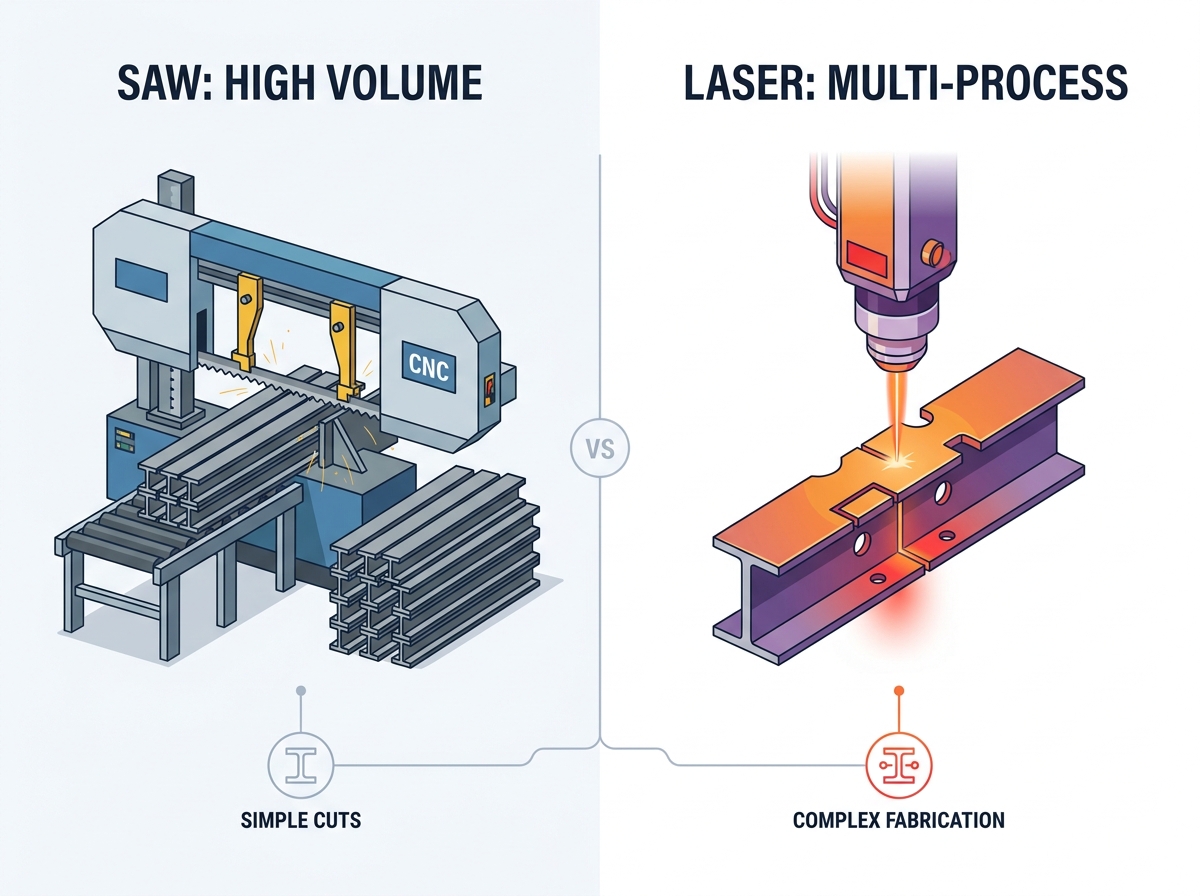
Capital expenditures in structural steel fabrication carry extremely high stakes. Every major machinery purchase shapes shop floor efficiency for decades. You face a distinct dilemma today. Shop managers must balance the proven, high-volume reliability of traditional saws against modern structural lasers. These newer lasers offer multi-process, high-precision capabilities. Making the wrong choice creates severe production bottlenecks. We will explore how to navigate this critical decision. This article provides an objective, factory-level framework. You will learn how to evaluate an industrial profile cutting system based on CAPEX, OPEX, throughput, and precise application requirements.
Key Takeaways
Production Mix Dictates Tech: Saws dominate high-volume, straight cut-to-length and miter operations; lasers win when extensive coping, slotting, and hole-making are required on the same beam.
Cost Reality: Lasers require a significantly higher initial investment (often 3x–5x) and higher operator expertise, but eliminate secondary processing stations.
Material Limits: Standard band saws handle massive, heavy-web H-beams effortlessly, whereas laser cutting faces strict thickness constraints and slower speeds on thicker flanges.
Footprint & Flow: Switching from a traditional drill-and-saw line to a laser requires a complete overhaul of factory material handling and cross-transfer logistics.
Analyzing Your Production Bottlenecks Before Evaluation
You cannot evaluate a new cutting system based solely on machine specifications. Fabricators often make the mistake of looking only at manufacturer cutting speeds. You must shift your focus from raw cutting speed to the total time-in-process per H-beam. A machine might cut a flange in seconds. However, if your operators spend twenty minutes deburring, drilling, and moving the beam to another bay, your overall efficiency drops dramatically. Success criteria should measure how quickly raw steel becomes a fully fabricated, ready-to-weld assembly.
Identifying your core application provides the foundation for this decision. You need a clear understanding of your typical project load. Assess the ratio of simple cuts versus complex fabrications. Ask yourself what your shop produces most frequently. If you mostly handle bulk distribution or simple structural frameworks, your needs differ significantly from a shop building custom architectural steel. Determine exactly how many holes, copes, and slots your average beam requires before it leaves the processing bay.
Labor and skill availability will heavily influence your success. Evaluate the current workforce carefully. Transitioning from basic machine operation to advanced CNC programming poses a massive challenge. Modern lasers require operators who understand optics maintenance, gas pressures, and complex CAD/CAM software. Saws generally require mechanical aptitude and basic numerical control knowledge. You must decide if you can upskill your current team or if you need to hire specialized technicians. Ignoring this human element often leads to expensive machinery sitting idle.
The Role of the Automated Band Sawing Machine in Modern Fab Shops
Traditional saws still anchor the majority of successful steel fabrication facilities worldwide. They provide unmatched reliability for high-volume batch cutting. Modern shops rely heavily on an automated band sawing machine to process massive quantities of structural steel efficiently. These machines easily handle bundle-cutting operations. You can stack multiple profiles and cut them simultaneously. Furthermore, they offer incredible cutting capacity for heavy-web H-beams. When you need to process wide flange beams with immense thickness, a bandsaw powers through the material consistently.
Operational expenses remain highly predictable. You do not have to worry about fluctuating assist gas prices or fragile optical components. The consumable costs remain completely transparent. You mainly purchase bi-metal or carbide-tipped blades and standard cooling fluids. Daily maintenance demands are minimal compared to optical systems. Operators easily learn how to check blade tension, monitor coolant levels, and clear chip conveyors. This predictability allows plant managers to forecast quarterly operating budgets with high accuracy.
Integration into existing workflows feels seamless. A precision structural steel saw typically acts as the primary anchor in a standard drill-and-saw line setup. Steel flows from the yard, through the drill line for hole making, and immediately into the saw for final length cutting. This linear progression matches legacy factory layouts perfectly. Roller conveyors and simple hydraulic cross-transfers easily support the pacing of a saw. The equipment communicates via basic NC files to synchronize feeding and clamping operations smoothly.
However, traditional sawing carries strict operational limitations. The process is strictly limited to two-dimensional cutting. You can only perform straight cuts and miter cuts. When projects demand complex connection holes, slotting, or intricate web cutouts, the saw cannot help. You must rely on secondary processing stations. This requires moving the heavy steel to separate routing stations, manual plasma bays, or thermal coping robots. Every time you move an H-beam to a new station, you lose valuable production time and increase overhead costs.
3D Laser Cutting for Structural Profiles: Beyond the Cut
Laser technology changes the fundamental approach to structural steel fabrication. Process consolidation acts as the primary driver for return on investment here. A modern 3D structural laser consolidates cutting, coping, marking, and drilling into one single automated setup. You place a raw H-beam onto the infeed conveyor. The machine handles every fabrication step in one continuous sequence. The beam exits the machine completely finished and ready for the welding bay. This consolidation eliminates work-in-progress inventory piling up between distinct processing stations.
Precision and edge quality reach unprecedented levels. Mechanical saws introduce physical force during the cutting process. This force can occasionally cause material distortion, especially on lighter profiles. Lasers utilize a zero-contact cutting method. They rely entirely on concentrated thermal energy and assist gases. The result is a perfect, mill-ready edge. The heat-affected zone remains remarkably small. This precision completely reduces the need for post-cut deburring or grinding. Welders appreciate the perfectly clean edges and exact tolerances.
Despite these advantages, you must evaluate the strict thickness constraints. Fiber laser wattage requirements scale dramatically as H-beam flange thickness increases. You need a realistic assessment of your typical material sizes. A 6kW laser might slice through thin architectural tubes instantly. However, it will struggle severely on heavy structural flanges. You face a severe speed drop-off on thick sections. The laser must pulse and slow down to prevent blowouts and maintain cut quality. Sometimes, a traditional saw outpaces a high-tech laser simply because the flange proves too thick for continuous thermal cutting.
Consumables and general upkeep present a different financial landscape. You must account for the hidden costs associated with thermal cutting. Lasers consume massive amounts of assist gases. You will constantly purchase bulk nitrogen or oxygen to clear molten steel from the kerf. Furthermore, the machine requires expensive protective lenses, specialized nozzles, and consistent chiller maintenance. Dust collection systems must run continuously to evacuate hazardous fumes. These ongoing requirements demand careful tracking to ensure they do not erode your profit margins over time.
CNC Band Sawing vs Laser Cutting Factory Economics
Understanding the financial impact requires a deep dive into your specific factory ecosystem. Evaluating a cnc band sawing vs laser cutting factory setup goes far beyond the initial quote. You must compare the initial equipment purchase price against the amortized cost per cut over a five-year lifecycle. Lasers demand a massive upfront capital expenditure. Saws offer a much lower barrier to entry. However, a laser might replace three distinct manual machines. You must calculate if the labor savings and process consolidation offset the high initial cost and expensive gas consumption.
Throughput and cycle times vary wildly depending on your exact scenario. We can break this down into two distinct operational realities. The table below illustrates the stark contrast between these two processing methods based on different project demands.
Production Scenario
Band Saw Performance
3D Laser Performance
Winner
Scenario A: High volume cut-to-length on standard heavy-web H-beams. No coping required.
Fast cycle times. Can bundle cut multiple beams at once. Low cost per cut.
Cannot bundle cut. Speed drops significantly on thick flanges. High gas usage.
Band Saw
Scenario B: H-beams requiring complex connection holes, slotting, and flange rat holes.
Requires moving the beam to a separate drill line and manual coping station. High labor time.
Completes all features in a single pass. Zero material relocation required.
3D Laser
Facility infrastructure demands also dictate your choice. Standard saws require basic industrial power and a level concrete floor. Lasers require massive power draws to operate the fiber source, chillers, and extraction units. You often need to pour specialized isolation foundations to prevent shop floor vibrations from affecting the delicate optics. Additionally, local environmental regulations might force you to install extensive dust and fume extraction necessities for the thermal cutting process. These infrastructure upgrades add significant unquoted costs to the laser installation.
Material handling automation requires careful evaluation. You must review how each system feeds and unloads heavy profiles. A saw operates in a linear fashion. A laser often requires complex rotational handling to cut all four sides of a profile. You must measure the footprint required for automated cross-transfers. Lasers process complex parts quickly, meaning your loading system must keep up. If your material handling automation lacks the speed to feed the laser continuously, you waste the incredible processing potential of the machine.
Implementation Risks in Heavy-Duty H-Beam Cutting Equipment
Upgrading your machinery introduces inherent operational risks. Inserting modern technology into an older facility requires careful planning. Purchasing heavy-duty H-beam cutting equipment affects every downstream process. You must anticipate these hurdles before signing a purchase order. The most common failures occur not from the machine itself, but from the factory environment surrounding it.
The Integration Trap: Many fabricators fall into the trap of inserting a high-speed laser into a legacy material handling system. Old roller conveyors and slow overhead cranes cannot feed the new machine fast enough. This leads to starving the machine. You end up paying for a highly advanced laser that sits idle waiting for the next H-beam to arrive.
Software & CAD/CAM Bottlenecks: Traditional saws run on simple NC files or manual inputs. Profile lasers require sophisticated programming. You face a difficult transition to full 3D structural detailing software like Tekla or SDS/2. Your detailing department must model every single cope, rat hole, and bevel perfectly. If your drafting team struggles to output clean 3D models, the laser cannot operate.
Maintenance Downtime: The reality of shop floor breakdowns differs greatly between the two technologies. Contrast the "swap a blade and keep running" reality of traditional saws with laser repairs. If a saw blade snaps, an operator replaces it in fifteen minutes. If a laser cutting head becomes misaligned or damaged by a rogue piece of slag, you face potentially days-long downtime. You must wait for specialized OEM technicians to arrive and recalibrate the optics.
Conclusion
Choosing the right cutting system comes down to an honest assessment of your daily production reality. Let your fabrication mix guide your shortlisting logic. Choose an automated band saw if your primary business revolves around heavy structural steel processing, bulk distribution, or straightforward cut-to-length contracts. A traditional saw provides unmatched reliability and cost control for heavy sections. Conversely, choose a 3D structural laser if you fabricate complex, lighter-weight architectural steel. The laser will immediately eliminate severe bottlenecks in your manual layout and thermal coping bays.
Take proactive steps before requesting formal quotes from machinery dealers. We highly recommend conducting a rigorous time-study on your shop floor. Select three to five of your factory's most commonly fabricated H-beams. Send these exact part files to the machine vendors. Ask them to provide real-world cycle times for both cutting and material handling. Compare those vendor times against your current manual processing methods. This data-driven approach guarantees you invest in the system that actually solves your production bottlenecks.
FAQ
Q: Which cutting method leaves a smaller kerf on H-beams?
A: Laser cutting leaves a significantly smaller kerf compared to sawing. The ultra-thin kerf of a fiber laser removes a microscopic amount of material. Band saws require a specific blade thickness to maintain rigidity, which removes more steel per cut. Over high-volume runs, the laser's thin kerf translates to measurable material savings.
Q: Can a laser cutter completely replace a drill line for structural steel?
A: Yes, for thinner profiles and complex architectural pieces. However, for massive structural jobs, standard drill lines remain faster and more economical. High-speed carbide drills push through thick heavy-web H-beams faster than thermal lasers, making traditional drill lines essential for heavy structural members.
Q: What are the ongoing consumable costs for both systems?
A: Saws require simple, predictable consumables: bi-metal or carbide blades and basic liquid coolant. Lasers rely on expensive assist gases like nitrogen or oxygen to clear the cut. Lasers also require replacement protective lenses, specialized copper nozzles, and consume significantly more electricity to run chillers.
Q: How does material condition (rust, mill scale) affect the cutting process?
A: Band saws easily power through heavy rust, dirt, and mill scale without issue. Mechanical teeth do not rely on surface purity. Lasers demand much cleaner surfaces. Heavy scale or rust causes laser scattering, requiring slower cutting speeds to prevent cutting anomalies and edge blowouts.