Investing in capital equipment for heavy steel fabrication carries extreme financial stakes. Fabricators must avoid crippling production bottlenecks at all costs. You also need to mitigate the severe financial impact of poor edge quality on thick plates. Standard sheet metal cutting relies on relatively lightweight processing systems. Conversely, heavy structural steel, carbon steel, and thick alloys demand intense thermal and mechanical capabilities. These dense materials require robust machines designed specifically to handle extreme heat absorption and massive physical weights.
We aim to provide a transparent, technical framework for your next equipment purchase. You will learn how to properly evaluate heavy-duty CNC laser systems. We focus heavily on verifiable performance data, long-term operational efficiency, and proven vendor reliability. You can then make a highly informed, profitable investment.
Key Takeaways
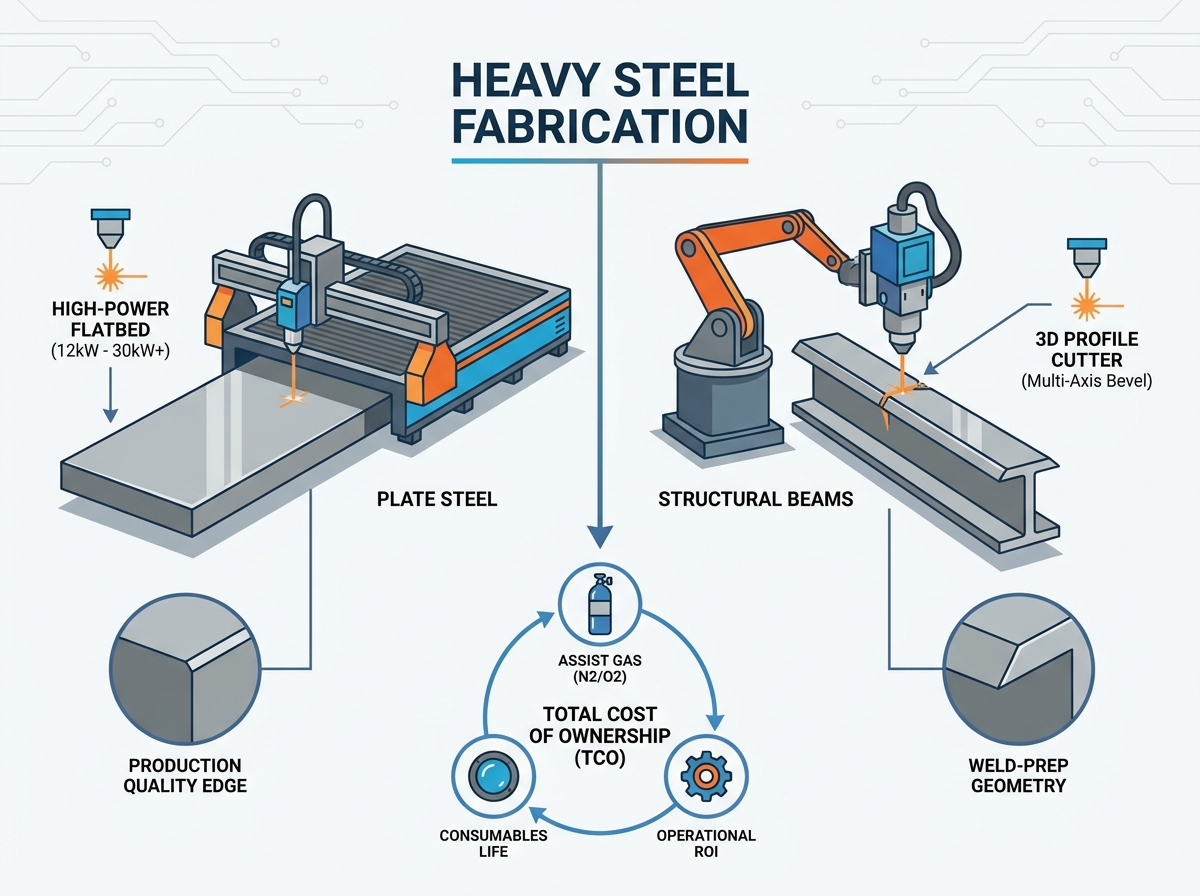
Power vs. Thickness: Baseline power thresholds (e.g., 12kW to 30kW+) directly correlate to edge quality and dross reduction on heavy plate carbon steel.
Form Factor Alignment: Flatbed handles plate steel, while dedicated 3D tube/profile systems are required for structural beams.
Total Cost of Ownership (TCO): Assist gas consumption (Oxygen vs. Nitrogen) and optical consumable life heavily dictate true operational ROI.
Supplier SLA: Machine specs matter less than the vendor's local parts availability and technical support infrastructure.
1. The Business Case: Defining Success for Heavy Steel Fabrication
Defining success accurately prevents costly buyer's remorse. You must differentiate between maximum pierce thickness and maximum production thickness. A machine might technically pierce 40mm steel. However, it might only cleanly cut 25mm steel during continuous production. Establish realistic cycle-time expectations for heavy plate processing. Base your capacity planning entirely on sustained production speeds, not peak laboratory metrics.
Precision laser edges drastically impact your downstream processes. They consistently eliminate expensive secondary operations. You can skip heavy grinding, milling, and manual beveling before welding. Clean cuts mean welders start their work immediately. This seamless transition prevents severe workflow bottlenecks on the shop floor.
Next, carefully validate your cost per part. Calculate your return on investment based on clear metrics. Factor in the machine amortization period. Include the daily consumable burn rate. Assess your overall labor efficiency. High-performance lasers require fewer operators. They also reduce the labor hours spent fixing bad cuts. We track these operational metrics closely to ensure long-term profitability.
2. Core Configurations of an Industrial Steel Laser System
A robust industrial steel laser system requires highly specialized hardware. High-tonnage flatbed machines demand exceptional frame rigidity. They need heavy-duty zoning configurations beneath the cutting bed. Structural stability is critical for handling thick carbon steel plates. A two-inch steel plate exerts massive weight on the machine frame. Lightweight sheet metal frames will warp under this intense physical load.
For structural profiles, you need dedicated processing hardware. Invest in high-quality precision H-beam cutting equipment. These advanced machines feature dynamic multi-axis bevel heads. They easily perform complex 3D cutting operations. This prepares exact weld-prep geometries directly on structural beams. Rotary attachments on flatbeds cannot handle heavy structural beams safely or accurately.
Format sizing must align closely with your raw material supplies. Consider the most common bed dimensions available. Many fabrication shops debate between 3015 and 6025 standard formats. Match your machine bed size directly to standard supplier plate sizes. This simple practice actively minimizes costly material scrap. It also maximizes your plate nesting efficiency.
3. Technical Evaluation: Specifying a High-Power Laser Cutting Machine
Evaluating a high-power laser cutting machine requires strict technical diligence. Laser source wattage directly dictates your cutting capability. You might choose 10kW, 15kW, 20kW, or even 30kW+ systems. Pragmatism is absolutely essential here. Extreme wattage offers diminishing returns for standard sheet metal. However, serious power remains absolutely necessary for piercing 20mm mild steel reliably. High power prevents dross buildup on the bottom edges.
Intelligent cutting heads prevent catastrophic hardware failures. Evaluate advanced autofocus features carefully. Demand robust active cooling mechanisms within the head. Prioritize protective glass monitoring systems. Heat management at the cutting head is vital. It represents the primary point of failure during thick-plate cutting operations. Overheated optics will destroy beam quality instantly.
Assist gas delivery drastically affects your operational budgets. Compare high-pressure Oxygen and Nitrogen carefully. Nitrogen cutting yields brilliant, oxide-free edges. Oxygen cutting introduces thermal reactions to assist metal melting. You must address the hidden operational costs of gas consumption. Massive gas usage ruins profit margins if left unchecked.
Assist Gas Type
Best Material Application
Edge Quality Result
Operational Cost Impact
High-Pressure Nitrogen
Stainless Steel, Thin Carbon Steel
Oxide-free, weld-ready, clean
Very High (high volume required)
Low-Pressure Oxygen
Thick Mild Steel, Carbon Steel
Oxidized edge, may need cleanup
Low (uses exothermic reaction)
Mixed Gas (Air)
Medium Steel, Aluminum
Slight oxidation, acceptable finish
Very Low (requires compressor)
4. Implementation Realities: Managing Downtime and Operating Risks
Managing downtime requires transparent maintenance planning. Wear parts demand your constant attention and tracking. Monitor your cutting nozzles, protective lenses, and ceramic rings daily. Set highly realistic expectations for maintenance intervals. High-power units inherently burn through delicate consumables faster.
Your physical facility must adequately support these massive machines. Assess these critical facility requirements before purchase:
Total electrical draw and dedicated transformer capacities.
Industrial chiller plumbing and spatial requirements.
Concrete foundation thickness and overall floor loading capacities.
Overhead clearance for material handling cranes.
High-capacity fume extraction and dust collection necessity.
Consider the internal component origins very carefully. The machine assembler's brand name often matters far less. Look closely at the core internal hardware parts. Compare trusted IPG and Raycus laser sources. Demand reliable servo motors like Yaskawa or Beckhoff. High-end Precitec cutting heads offer superior longevity. These premium internal components ultimately determine your actual machine uptime.
5. Scaling Throughput: Integrating an Automated Fiber Laser Line
A lightning-fast cutting machine inevitably creates a new problem. Material handling quickly becomes your primary production bottleneck. An ultra-fast laser is virtually useless otherwise. It wastes valuable hours waiting for heavy steel plate loading. Manual crane loading simply cannot match modern laser speeds.
Evaluate automated load and unload systems rigorously. Pallet changers keep the laser active continuously. Shuttle tables offer fast material swapping outside the cutting zone. Heavy steel plates require robust suction-cup lifting arrays. Specialized vacuum lifters handle thick carbon steel safely. They prevent dangerous drops and protect material surfaces from deep scratches.
Consider adding vertical material storage towers. This upgrade modernizes your entire setup. You create a fully integrated automated fiber laser line. Flexible Manufacturing Systems (FMS) enable safe lights-out operation. Continuous shift operation maximizes your equipment utilization rate. Automation guarantees a faster return on your initial capital investment.
6. How to Vet a CNC Laser Cutting Machine for Steel Supplier
Vetting vendors proactively protects your massive capital investment. Partnering with a reliable cnc laser cutting machine for steel supplier requires moving past the sales pitch. You must validate claims physically and contractually. Follow these crucial steps during the vendor evaluation process:
Demand strict Service Level Agreements (SLAs) in writing.
Define guaranteed field technician response times for your region.
Verify their domestic spare parts inventory immediately.
Confirm they stock complex parts, not just simple consumables.
Execute a live proof-of-concept cut on your own material.
Investigate their spare parts inventory closely. Buying imported machines carries massive operational risk. You strictly need a domestic or regional parts warehouse. Waiting three weeks for a simple proprietary sensor halts production completely. Localized technician availability is absolutely non-negotiable for heavy fabricators.
Never skip the physical proof-of-concept cut. You must validate cutting claims physically. Demand live test cuts at their facility. Provide your own heavy material samples. Ensure they utilize the exact machine wattage specification quoted. Do not rely entirely on printed spec-sheet claims.
Conclusion
The best machine balances raw piercing power with extreme structural rigidity.
Predictable operating expenses matter just as much as cutting speed.
Heavy steel requires specialized automation to prevent material handling bottlenecks.
Vendor support networks dictate your long-term success more than hardware specs.
Take action by finalizing your material thickness and volume matrix today. Document your daily throughput requirements clearly. Then, issue a detailed Request for Quote (RFQ) to shortlisted vendors. Always request customized time-studies based on your actual part files to guarantee performance.
FAQ
Q: What is the minimum laser power required to efficiently cut 1-inch (25mm) carbon steel?
A: Efficiently cutting 1-inch carbon steel requires at least 12kW to 15kW of continuous fiber laser power. Lower wattages can technically sever the metal. However, they struggle to produce a clean, dross-free edge. For continuous production without secondary grinding, many heavy fabricators prefer 20kW systems.
Q: Fiber Laser vs. Plasma: When should a heavy steel fabricator choose plasma instead?
A: Choose high-definition plasma when cutting extremely thick plates over 30mm. Plasma is ideal where tight dimensional tolerances are less critical. Fiber lasers dominate up to 25mm due to superior precision. Plasma offers a better equipment cost ratio for raw severing of ultra-thick structural steel.
Q: How much does it cost per hour to run a 20kW heavy-duty fiber laser?
A: Running a 20kW heavy-duty fiber laser typically costs between $30 and $60 per hour. This calculation fluctuates based on local electricity rates and assist gas choices. High-pressure Nitrogen significantly increases hourly expenses compared to Oxygen. You must also factor in routine consumable replacement rates.
Q: Can a standard flatbed laser be retrofitted for tube or H-beam cutting?
A: Yes, but with severe mechanical limitations. You can add a basic rotary attachment to a standard flatbed. However, this only accommodates lightweight round or square tubes. Heavy H-beams require dedicated multi-axis structural machines capable of maneuvering safely around complex web flanges.