Tower erection delays frequently stem from a surprisingly straightforward bottleneck. Site crews encounter missing, illegible, or incorrect component identification upon delivery. You lose precious operational hours when workers struggle to identify specific structural members. These seemingly minor erection delays multiply your field labor costs rapidly. We must clearly define the exact data points required for seamless tower assembly. Modern fabrication facilities integrate this critical data application step automatically into their core production processes. An automated marking process within your workflow completely eliminates manual data entry errors. It guarantees absolute structural traceability for every fabricated piece. You will learn how upgrading your identification strategy directly accelerates field erection schedules. We highlight how deploying advanced machinery protects profit margins and ensures strict industry compliance before structural components ever reach the construction site.
Key Takeaways
Every angle steel component requires a Unique Part Identifier (UPI), material grade, and orientation markers before leaving the fabrication facility.
Manual marking introduces high margins of error; automated integration via a CNC Angle Drilling Marking Line is the industry standard for accuracy and throughput.
Character depth must be precisely calibrated to remain legible after hot-dip galvanizing without compromising the structural integrity of the angle steel.
Upgrading to an automated steel tower marking machine requires evaluating CAD software compatibility and character-stamping cycle times.
1. The Financial and Operational Cost of Incomplete Assembly Data
Incomplete assembly data devastates project budgets. Erection downtime serves as the most immediate financial penalty. Site crews waste countless hours sorting unmarked angle steel. Unmarked components force workers to measure hole pitches manually. They must compare physical parts against massive paper blueprints. Every minute spent searching for the right part burns your labor budget. Ambiguously marked components cause severe project scheduling delays. Crane rentals sit idle while riggers verify part numbers. This inefficiency ruins your daily erection targets.
Traceability and compliance risks introduce massive long-term liabilities. Missing material grades compromise quality audits entirely. You cannot easily document heat numbers during mandatory structural reviews. Structural failures often trace back to undocumented material substitution on site. Quality inspectors demand clear, permanent identification for every load-bearing member. Undocumented steel grades fail to meet stringent national grid standards. You face severe legal consequences if a tower collapses due to incorrect parts.
Rework and scrap compound these financial losses further. Misidentified components force unintended structural misalignments during assembly. Field crews must often resort to unauthorized field-drilling. They modify parts to fit, which compromises the engineered load capacity. Sometimes, they must completely replace the mismatched component. Returning scrap steel to the fabrication shop delays the entire project. This destroys your erection schedule and depletes your material budget.
2. Essential Marking Data for Angle Steel Components
Clear data ensures correct assembly from the ground up. We recommend standardizing several vital identification markers across your production line. Proper planning prevents catastrophic assembly failures.
Unique Part Identification (UPI): You need distinct alphanumeric codes. They link physical parts directly to erection drawings. Typical designations include Leg, Diagonal, or Cross-arm markers. Operators rely on UPIs to position parts accurately.
Material Traceability (Heat/Mill Numbers): You must mark steel grades clearly. Grades like S355 or Q345 demand absolute visibility. High-stress joints require the correct structural capacity components. Heat numbers link the steel back to the original mill certificate.
Orientation and Bending Indicators: Reference marks guide secondary shop operations. Components might require CNC bending post-machining. Proper reference marks ensure correct directional alignment during bolting. They prevent asymmetrical parts from being installed backward.
Match-Marking for Complex Nodes: Sub-assemblies present unique logistical challenges. Fabricators often pre-fit these complex nodes in the shop. They disassemble them later for highway transport. Match-marking ensures seamless and accurate reassembly on the job site.
Common Mistake: Relying solely on paint pens or adhesive labels. Paint burns off during welding or washes away in rain. Labels dissolve entirely in the hot-dip galvanizing bath. You must utilize permanent stamping methods.
3. Integrating Data via a CNC Angle Drilling Marking Line
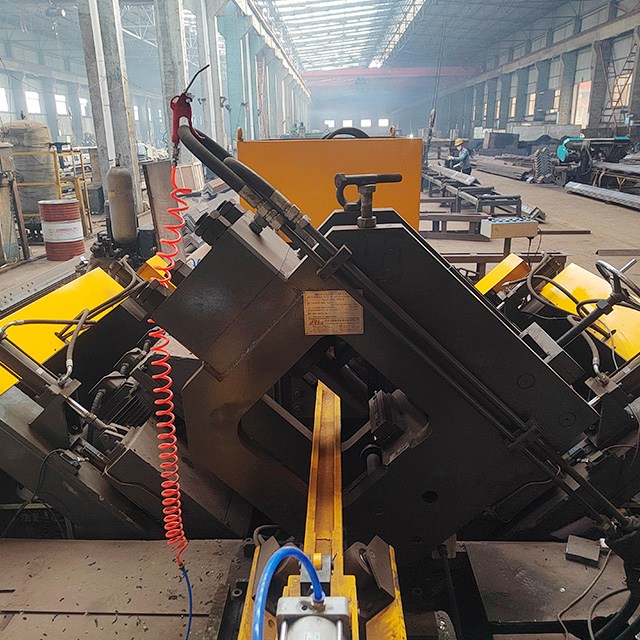
Manual marking slows production down drastically. You can solve this bottleneck by linking CAD/CAM software to shop floor machinery. A modern CNC angle drilling line reads DSTV or DXF files seamlessly. It extracts all required marking data automatically from the 3D model. It processes this text data alongside hole-punching and shearing coordinates. Operators no longer type part numbers manually. This software integration eliminates human transposition errors entirely.
This automated workflow eliminates secondary material handling. Inline marking offers a massive workflow advantage for any busy fabricator. The angle drilling machine stamps components simultaneously during the drilling process. You maintain a zero-delay throughput across the entire shift. Operators do not need to move heavy parts to a separate marking station. The material feeds into the machine once, and it exits fully fabricated. This parallel processing boosts your daily tonnage significantly.
We must also compare hydraulic stamping to mechanical scribing. Hydraulic character cassettes provide superior longevity. They withstand heavy steel environments and abrasive mill scale effortlessly. Scribing tools wear down quickly on tough structural steel. Hydraulic stamping ensures deep, legible marks through brute force. A hydraulic cylinder presses hardened steel characters into the flange. This creates a permanent impression without removing material. The stamped impression easily survives decades of weather exposure.
4. Evaluation Criteria for a Steel Tower Marking Machine
You must evaluate equipment carefully before committing to a purchase. Character depth directly affects your galvanization allowances. A stamping depth between 0.5mm and 1.5mm is usually ideal. Deep marks survive aggressive abrasive blasting prior to coating. They remain highly visible under thick zinc coatings during hot-dip galvanization. Thin or shallow marks simply disappear under the zinc layer.
Stamping speed determines your overall production cycle time. Characters-per-second metrics significantly impact your facility output. Faster indexing increases the overall tonnage-per-shift capacity. Your fabrication line runs more profitably when marking operates swiftly. Sluggish character wheels create frustrating bottlenecks in the feed cycle.
Tooling durability heavily influences your long-term consumable costs. Character blocks utilize specialized, hardened tool steel. You must evaluate their expected lifespan under continuous, multi-shift operation. Quick-change cassettes allow easy swapping of character sets. This flexibility helps when shifting between different regional production runs. You want character wheels that index smoothly without jamming.
Finally, verify software compatibility before installation. Your steel tower marking machine needs native integration capabilities. It should connect smoothly with industry-standard detailing software like Tekla Structures or AutoCAD. Native integration prevents complex file conversion issues on the shop floor.
Even the best equipment encounters operational challenges during daily use. The "filled mark" problem occurs frequently during the galvanization process. Liquid zinc pools and hardens inside the stamped characters. This obscures the part number completely. You can implement simple operational workarounds to prevent this. Operators should adjust hydraulic pressure based on the material thickness. Thicker zinc coatings require deeper initial stamping. You must calibrate the pressure to avoid fracturing thinner angle profiles.
Data entry vulnerabilities pose another significant operational risk. Manual operator overrides at the CNC console cause terrible errors. Workers sometimes type incorrect designations out of habit or fatigue. We strongly advise locking automated data feeds directly from the engineering department. This strict protocol prevents operators from typing incorrect UPIs. The machine should only execute the exact code provided by the 3D model.
Preventative maintenance keeps the marking system reliable. You must establish strict baseline maintenance requirements for your team. Check the hydraulic marking unit daily before production begins. Routine checks prevent uneven stamping depths across different components.
Follow these baseline maintenance steps:
Inspect character blocks for uneven wear or chipping before each shift.
Lubricate hydraulic cylinder rams weekly to maintain consistent stamping force.
Verify CAD file imports against the latest engineering drawing revisions.
Calibrate pressure settings for varying steel profile thicknesses periodically.
Best Practice: Keep a dedicated logbook for character wheel replacements. Track the tonnage processed by each character set to predict wear intervals accurately.
6. Shortlisting and Next Steps for Fabrication Plants
Start your upgrade journey with a comprehensive workflow audit. You need logical steps to identify your current manual marking bottlenecks. Calculate the potential return on automation investment accurately. Track exactly how many hours your crew spends fixing marking errors. Observe the time lost when workers manually stamp parts with hammers. This audit reveals the hidden labor costs draining your budget.
Next, demand physical sample verification from potential machinery suppliers. Procurement teams should request stamped angle steel samples. Run these specific samples through your preferred galvanizing vendors. Ensure the characters remain easily visible after the actual zinc bath. Do not rely on ungalvanized samples to judge stamping quality.
Establish strict vendor selection criteria before making a final decision. Shortlist equipment providers based on local service availability. Confirm they maintain a robust spare parts inventory domestically. You will frequently need replacement character wheels as production scales. Reliable software integration support is equally crucial. A true CNC Angle Drilling Marking Line partner offers extensive remote troubleshooting. They guide your operators through initial software handshakes and parameter adjustments.
Conclusion
Component marking is never a secondary or optional task. It serves as a critical prerequisite for structural integrity and project success. Accurate data ensures rapid and safe field assembly for site crews. Missing marks lead to massive project delays and budget overruns.
We highly recommend transitioning away from outdated manual identification methods. Upgrading your shop floor protects your hard-earned profit margins. It helps your facility meet strict industry compliance standards effortlessly. Accurate identification eliminates costly reworks and hazardous field modifications.
Take action by auditing your current labeling errors this week. Request stamped steel samples from equipment vendors this quarter. Upgrade your fabrication data flow to guarantee perfect tower erection every time.
FAQ
Q: What is the standard character depth required for steel tower components?
A: The standard stamping depth ranges from 0.5mm to 1.5mm. This depth ensures the characters remain visible after abrasive blasting and hot-dip galvanizing. Operators must balance depth against material thickness to avoid causing stress fractures in thinner angle steel profiles.
Q: Can a CNC angle drilling marking line process both letters and numbers automatically?
A: Yes. Modern equipment features CNC-controlled character cassettes. These rotary cassettes index both letters and numbers automatically based on software instructions. The machine reads the CAD file and rotates the wheel to stamp full alphanumeric strings without manual intervention.
Q: How does the marking process affect the overall speed of the angle drilling machine?
A: The impact on cycle time is negligible. Inline marking operates concurrently with material positioning or drilling processes. Because the marking unit stamps components while the main carriage moves or clamps, it rarely slows down the overall tonnage output.
Q: What file formats does a steel tower marking machine require?
A: Industry-standard machines primarily require DSTV (NC1) or DXF file formats. These files export directly from detailing software like Tekla Structures. They encapsulate specific marking strings alongside geometric data like hole coordinates and cut lengths.